Above you will find a digital copy of Cassette 2A, recorded by Victor Gruder. What follows below is our best efforts at transcribing the contents of the recording. Occasionally, an informal translation or editorial aside is inserted in square brackets ([ ]) for clarity or context. Anything underlined is a hyperlink. As with the title of each “Letter”, they are our addition, and we deserve all blame for incorrect statements or assumptions.
…………..
He was a sharpshooter. He did all the things he was supposed to do but, try as he may, he was unable to look martial. He just didn’t. Even standing at attention, it looked as if he were slouching. It was the most unmilitary appearance imaginable and this I’m telling because it does play a role later on. In private life he had been a schoolteacher. He spoke some four or five Slavic languages, some French, but he didn’t speak any German. He spoke Yiddish of course, but no German. Well, that much for Salzman to set the stage.
There was great excitement, of course, in the compound, in our headquarters, because a German general was gonna be brought in and the executive officer made all the tactical arrangements and he selected me to do the translating between the two generals and I was to wait and stand by until called. Well, eventually there came a command car and they had the good idea to dress the general in a GI raincoat, presumably so that the French wouldn’t stone him on the way, and they came in not where they were supposed to come in but by another entrance through the hedgerow, with the result that the general was ushered into the presence of General Holland and I wasn’t there to translate. By the time they told me, I rushed to the door, accompanied by about fifty-six other guys curious about the German general, and as we arrived at the door, we just heard General Holland say to Salzman, “You translate.” Well, this wasn’t the time to tell General Holland, who assumed that anybody speaking languages of course would speak any language needed — it wasn’t the time to tell him that he didn’t speak German. So, he stood very soldierly at attention, at parade rest (which means legs apart, hands folded behind his back,) and attentively listened to the German general. That German was, of course, pale and excited. He had a pince-nez on and looked more like a postmaster than a general and he unleashed a flood of words. I perhaps better give it in English. He said, “I am no coward. I was in an impossible situation. I was not gonna see 50,000 people slaughtered. I am a soldier, I’m not a butcher.” And this went on and on very excitedly and it ended by a statement, “General Eisenhower knows this, and General Bradley knows this, and I want General Holland to know this.” Well, Holland sat at his desk, trying to look very serious and grim, puffing on a cigar. When he heard his name mentioned, he turned to Salzman and said, “What did he say?” and Salzman thought for a moment and said, “He said he couldn’t help it.” And that, in my opinion, was summing it up very nicely indeed.
A few weeks later The Breakthrough had been accomplished. The army moved on and eventually we followed and moved to Etampes, halfway between Orléans and Paris, where we again pitched tents in cabbage fields which the Germans had planted, and we were allowed to wash in an establishment which the Germans had constructed for their communication headquarters, and we were close to Paris. And then word came: Paris had been liberated. And there we sat, everybody anxious to get to Paris, but we couldn’t. Well, I wrote a formal letter requesting permission to go to Paris to see the grave of my mother which I had never seen, and to look whether there were any of the possessions I had left behind, and whether I could help any of the people who had helped my parents. It took a while before this document made its way through channels and eventually it came back with a lot of stamps and signatures of high brass, appreciating the request of that soldier but unfortunately, during wartime there is no such things as leave and leave could not be granted, but, it was suggested, if an occasion should arise where an official trip to Paris would be necessary, perhaps it could be arranged to have this soldier go along and they expressed certainty that the soldier would not abuse this privilege. Well, that was the end of that….
But the people were — my fellow soldiers and the officers — were all so excited about going to Paris that they took jeeps and went, and the major I worked for said “come along” and so we set out for Paris, illegally. And, well, I showed them the sights which didn’t interest them in the least. They wanted to get their hands on some booze and presumably on some girls, and an appointment was made to meet at a certain place near the opera at four o’clock for the return trip. At four o’clock a very stoned major — he was a banker in private life — appeared and says, “Vic, I want you to meet a pal of mine. He’s the Provost Marshal of Paris. I’ve talked to him about you, and he wants to interview you.” Alright, and we walk into a building, and he says, “Meet Major Hitler,” and I nudge him, said, “For God’s sake, don’t make such jokes!” But it turned out that the Provost Marshal of Paris was a Jew by the name of Paul Hitler who didn’t speak a work of French or German and was delighted to meet somebody who knows Paris and knows French. And he informed me after about five minutes that he was going to ask for my transfer to Paris. Fine. We return.
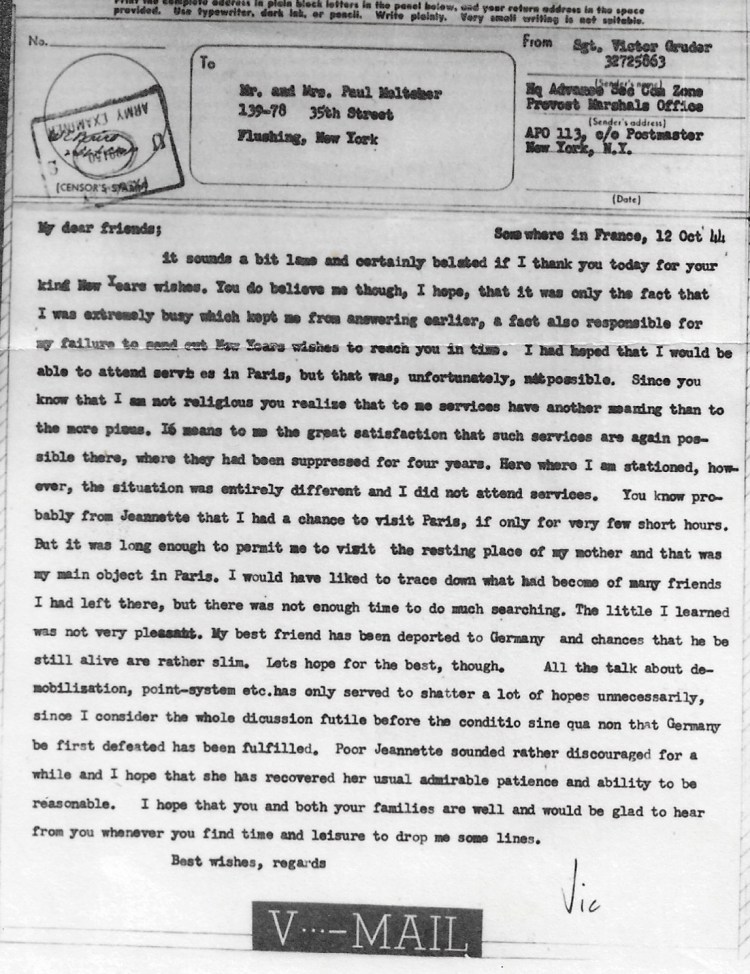
The next morning all hell broke loose. General Holland had called, asking for my transfer pursuing to the interview the Provost Marshal had had with me, and he said, how on earth did you have an interview? Well, I sort of kacketzed [stuttered, stammered] around and by that time they got hold of the major who came in and took the whole responsibility for this and he got chewed out for doing what he had done and of course nothing came of my transfer. I went with my outfit straight through Paris – at that time Parisians still cheered passing trucks with American soldiers in it, and the soldiers threw out candy and cigarettes and what have you — and we went right through Paris to Reims where we for the first time were able to sleep in not quite a bed but, anyway, inside a building, on some straw mats, in a school.
Reims was an interesting place because the Germans had fled the city, the Patton’s 3rd Army tanks had rolled right through the city, and we were the first Americans arriving and staying there. So, the Reimoins [citizens of Reims] had prepared for a long siege and had nobody to share this with. The siege didn’t take place. And I set out to find a shower somewhere, ran into a young Frenchman who was delighted to hear that I spoke French and took me on his bicycle (I had also borrowed one) to a place where I could take a shower, and then sort of haltingly asked me: his mother had told him to bring home an American for dinner. Would I care to come? And I said, “Well, I always go everywhere with another friend of mine who also speaks French.” He said, “Well, my mother actually told me to bring two Americans.”
So, we appeared for dinner at the place and found a rather nice bourgeois apartment all decked out with little American and French flags with about two dozen people there, all family and friends, who began singing the Marseillaise and cheering the liberators. Well, Jerry, my friend, and I were the liberators. At the end of a very delicious dinner the hostess told us that she was able to get white bread from her boulanger (on the black market of course,) only under the condition – she told him that she had two American visitors, and he gave her the bread under the condition — that these Americans come to him for dinner. Which we did, and we met the butcher and the candlestick maker, and it was a very gay and interesting crowd. And we were handed from one to the other for dinners.
As a matter of fact, throughout something like over two and a half weeks in Reims I didn’t even know where the mess hall was. All our meals were taken care of by the notoriously cold-hearted Reimoins; they weren’t cold-hearted at that time! As a matter of fact, I went to a bookstore and browsed around and asked permission to look at things and I admired a book which was illustrated with lovely aquarelles and asked him what the price was. And it was way beyond what I could pay and — which I told him — and he invited me for dinner, the bookstore owner. And after dinner, which was an intimate dinner (just his wife,) after dinner I went back to my sleeping quarters and when I reached in the pocket of my coat, I found the book in there. These were rather lovely experiences.
I don’t want you to think that all the, that the whole war was a succession of funny anecdotes. There were some grim events. Among them seeing trucks come back with, filled to the brim with corpses. Sometimes Americans, sometimes Germans. It doesn’t make any difference; it’s a terrible sight. Bombed-out houses, whether they’re in France, whether they were later in Germany — the corpse of a house is a very sad sight no matter whose house it is.
Now let’s return to the account of my military career. One day General Holland called me over and said “Say, you once asked for leave to go to Paris. You never did get to Paris, did you?” “No, General, I didn’t.” “Well, I tell you. Write yourself orders and you have five days to go to Paris and find yourself a job in Paris.” You know, in the middle of a war, you go job-hunting. Well, I went to Paris and went to a building on the Place de l’Opéra, the Banque d’Escompte, and in there I went actually, literally, from office to office and inquired whether anybody needed somebody, a soldier, who knew Paris well and spoke French. By accident, I walked into the General Purchasing Office, headed by a colonel, assisted by a major and a bunch of French people in there with whom I spoke French — which apparently impressed the major — and, yes, indeed they could use me there and so, I was transferred to the General Purchasing Office, of Seine Area Command Headquarters Communications Zone. That, incidentally, was the same headquarters with which I had been all along, and I mention the full designation because it plays a role later on, many years later. [ed: see Letter 11 “Dackels, Nice, and Orléans”]
There started very interesting work. I was concerned with the administration of certain aspects of lend-lease and reverse lend-lease. As a matter of fact, you might not know what that is. It was an arrangement whereby the U.S. was delivering to the French, arms — to the Free French army — arms, uniforms, food, every support; and the French in turn were putting up French Franc counterparts and were paying expenditures made by the U.S. army in France. An accounting to be made later on. This was called “lend-lease,” and the French portion of it was called “reverse lend-lease.”
I also, of course, started looking for my friends. I marched into the préfecture in uniform and demanded to know what had become of Frida Kalmus, “Dicky”, [ed: Dicky and Viggi had married in the meantime, so she was no longer Neumann but rather Kalmus] and other people and was told, with the usual attitude to be expected from a police official in the préfecture, “but he cannot give me this information, it’ll take some time to dig it up.” I had explained why I wanted to know, and he said he needs permission from the sous-préfet to do this. Well, I marched down to the sous-préfet, walked into the office, and really bullied my way through. The huissier really wanted to know “de quoi il s’âgissait” [what this was all about] and I told him “I’ll tell this to the sous-préfet directly” and marched into the office of the sous-préfet. Well, this measure of chutzpah did get me the information within a half-hour, and I got an address. I found it wasn’t the last known address of Dicky — to which I went and heard that she had moved — but eventually I found her. As a matter of fact, I called on the telephone and said hello and she recognized my voice. Well, I’m not going to tell you all the things that have happened in Paris.
One little incident is perhaps worthy of note my office was in that building of the Banque d’Escompte. Later on, when my father described more closely where he had gone to ask for permission to go to the liberated zone of France – you know France was divided into a free zone which was not occupied by the Germans at first (later on it was,) and the occupied part, the northern part. Incidentally, to describe my father: he had marched into the office of a German — not Gestapo but German equivalent of — the Provost Marshal, the Feld gendarmerie, he marched in there and informed them, “Ich bin der Doktor Gruder aus Wien. Ich bin ein Jude. Ich bin ein Sozialist. Ich bin seit eh und je Ihr Gegner gewesen. Sie können mich nicht gebrauchen und ich kann Sie nicht gebrauchen. Ich wünsche, einen Pass zu bekommen, mit dem ich nach Montauban fahren will, wo ich auf das Visum warten will, das mein Sohn mir aus Amerika schicken wird.” [“I am Doctor Gruder from Vienna. I am a Jew. I am a Socialist. I have been your opponent since ever. You have no use for me and I have no use for you. I wish to receive a passport with which I want to drive to the free zone, to Montauban, where I want to wait for the visa that my son will send me from America.”] The man just stared at him for a whole minute, didn’t say one word, and gave him a laissez-passer. Now this, in order to understand my father, was neither courage on his part nor a particular clever trick. He was just a man without guile. Totally without guile. And, apparently, he did look impressive. And, well, he did impress the man; he gave it to him. And what was so interesting is that the office in which this took place was two doors down from the office which I occupied when I was in this building. That isn’t all that much of a coincidence because in order not to deprive the French of their — rather, there was a great shortage of available housing. Well, the US army outfits always moved into places which had previously been occupied by German outfits. But nevertheless, I find it interesting
I met another great number of — no, it wasn’t a great number but a number of — people who had survived and who sort of showed up. This is when I met the Vibacs, through Dicky, other friends of Dicky’s who had hidden her throughout the war, where she slept never more than two nights in the same apartment, and where she had survived by evading too close a check by the French police of her false identity papers by going to the theatre because that was the time when the French made the rafles [raids, round-ups] and they didn’t look in the theatre. She saw a lot of plays. And she was always very well dressed. Well, that is another story which I may or may not tell you later.
A very hard and cold winter started. The French had not been able to eat a decent meal for a long time and they were starved (and obviously particularly the people who had been in hiding,) and I furiously wrote to their relatives in the States whenever there were some relatives, who started sending parcels to me for them, which was of course slightly illegal but who cared? My colonel and my major knew all about it and as a matter of fact they called me a one-man UNRRA (UNRRA was a relief organization taking care of refugees,) and I had sometimes twenty parcels in a closet to distribute to various people.
This is also the time when I met Jacqueline Guinle and saw her parents in Orléans and it wasn’t exactly a gay time because the time was rather grim, but it was a great joy to be able to help.
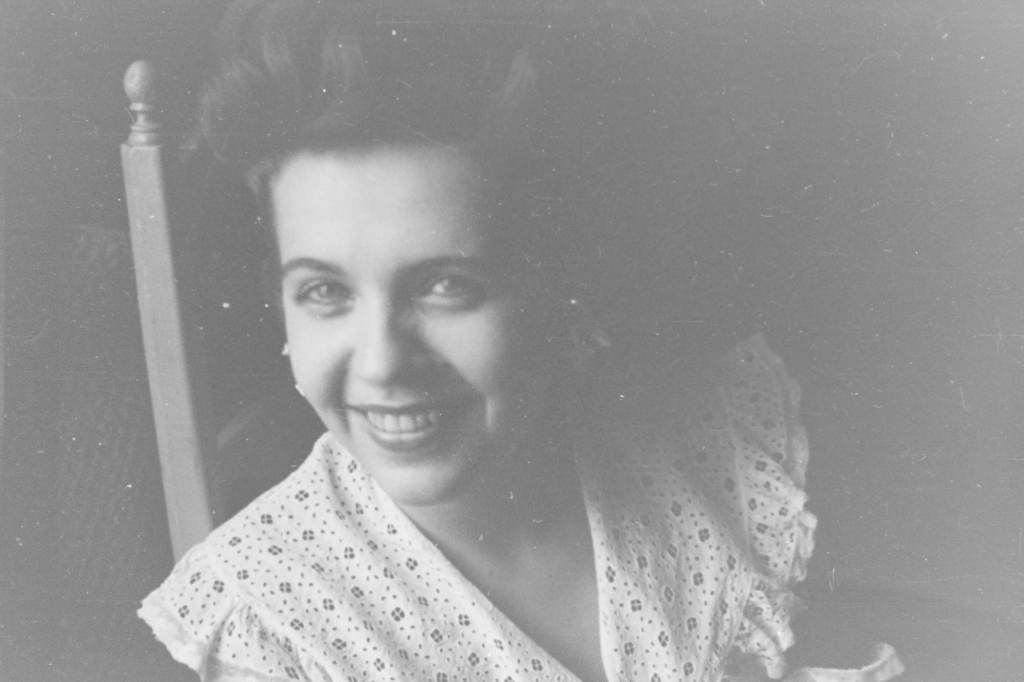
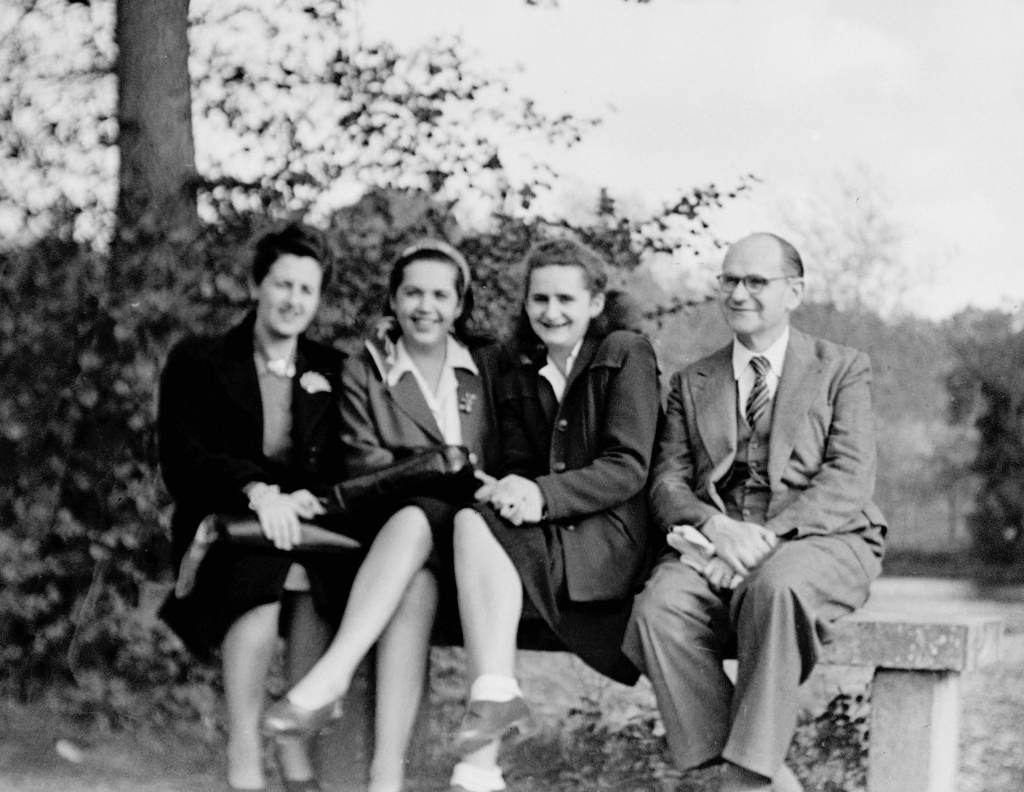
I was able to get jobs for more than a dozen people in the PX, and working for this outfit and that outfit, and got a secretarial job for Dicky, and it felt good to do something constructive.
Then came V-E Day. The end of the war in Europe. I was in Orléans at Jacqueline’s parents and that is where we heard the announcement by de Gaulle that the war had ended. I don’t think I am enough of a writer or a storyteller to convey the mood in which this was received. It was pandemonium. The Orléanais are not known for being particularly gay or joyful people, but all hell broke loose. People were running through the streets, strangers kissing each other, there was true joy and celebration, and the wine flowed, and we didn’t sober up for three days.
Shortly thereafter there began the scramble for how to get home. You had to be ordered home. That is, that had to be done in a certain orderly fashion; and they invented a points system. Wounded people got extra points, the length of service, whether you had been at the front, and what have you.
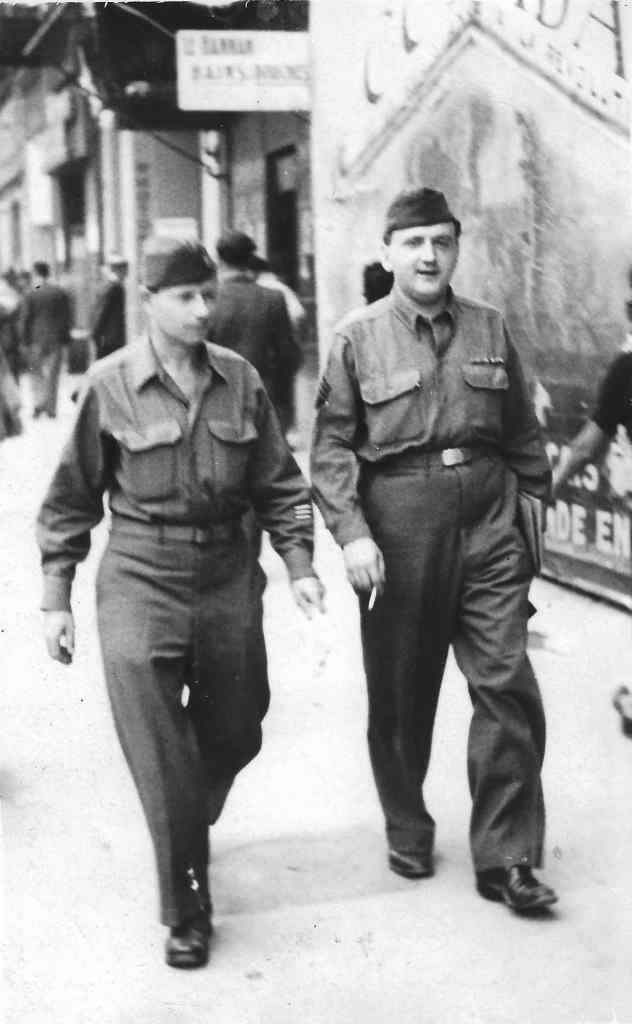
And just then I got, through the Red Cross, notification that my father was in the hospital very seriously ill, and I was granted emergency leave to get home. I was flown to Bangor, Maine which was where we landed and there was no plane. We were snowed in and there was no plane to New York. I took the train and arrived at two o’clock in the morning, called Mommy from the – yes, I had called her of course before; I had called her once before from London; I had written to her; she knew I was supposed to come — and I woke her up by calling from Pennsylvania Station, and she had been fast asleep, and I said “Well, I’m at Pennsylvania Station.” She [ed: sounds of Victor’s laughter] answered me: first words she said, “Well, come right home.” [ed: more sounds of Victor’s laughter]. Needless to say, I did.
Once again after interrupting my recording I listened to what I had said before. And several things occurred to me. There is one major flaw in this method of talking, of writing, and that is the written word, the written product, can be revised, can be corrected. Faults, syntax, misspeaking, what have you, can be corrected. Now, that is almost impossible to do on a cassette. You can do it on an open reel but not on a cassette. So, I want you to know that I am aware that there are numerous mistakes and just give me credit that, had I written it, I would have made the necessary corrections.
Another thing that occurred to me is that this is very seductive to telling anecdotes, mostly amusing anecdotes, and it does very little to convey to you the atmosphere of a period you didn’t know. This is true whether we are talking about France during the occupation of France, during the war and immediately after, whether we are speaking of Vienna as it was. It occurred to me for instance that I left Vienna in jail; my story never got myself out of that jail. I surely have to return to this and complete at least that portion.
Considering that the whole generation of young people regards something like the Holocaust pretty much as in my generation one regarded the slaughter of the Armenians by the Turks: something almost inconceivable. One takes note of a historical fact, and it remains as remote as gladiators who were killing each other or killed by wild beasts in Rome. It must have struck you that perhaps several of the events I related may make it appear that perhaps things weren’t entirely black or white during the Nazi period. Now let’s not make any mistake about it. Nazism meant a program, a government program. It was applied enthusiastically by those who supported the program, and it was tolerated at least with a shrug of the shoulder by those who didn’t take the initiative.
 Victor Gruder