Above you will find a digital copy of Cassette 2B, recorded by Victor Gruder. What follows below is our best efforts at transcribing the contents of the recording. Occasionally, an informal translation or editorial aside is inserted in square brackets ([ ]) for clarity or context. Anything underlined is a hyperlink. As with the title of each “Letter”, they are our addition, and we deserve all blame for incorrect statements or assumptions.
………………..
We’re speaking of a nation of millions of people, and there is no such thing as a generalization which would apply to every single one of them. Also, any kind of a bureaucracy — and may it be as methodical as the Germans are and as thorough as the Germans are — breaks down once in a while. Sometimes, for instance, it was the very thoroughness which led to the opposite result, opposite of what the Germans wanted to do. I’ll give you an example.
The Germans, the Nazis, in one of the concentration camps, took away all the Aryan-looking — or children that by their definition were children of Aryan parents, and gave them new names and made them available for adoption to childless couples who wanted children and who were good Nazis. This happened in Poland. Now these children were of a tender age, and they were brought up by these parents in most cases in a rather decent way. That is, they were loving parents, as people who adopt children often are because they know what they are doing. And this went on until the end of the war.
And then when digging around the Allied authorities found a record; somebody had recorded the names of all the children who had been brought to this concentration camp (incidentally they were all double orphans; their parents had been killed, gassed,) and together with the name of their adoptive parents so that they could be traced. Now some methodical Nazi official had made a record of this horrible story, of that horrible deed, and somebody, perhaps as a matter of conscience, buried it.
That’s how the UNRRA officer found it — who incidentally came to us (“us” means the legal division in Wiesbaden, the legal division of military government in Wiesbaden) — and he asked our advice. His problem was the following: these children, and he related the whole story to us, had been children of Polish officers, of Poles, and the Polish government insisted that these children must be returned to Poland because Poland had lost a whole generation of young people in the war, and they needed these children. But, said the UNRRA man, it meant taking these children away from the only parents they know, taking them away and putting them in orphanages in Communist Poland. At that time, it wasn’t particularly important whether it was communist or not but what was important was that the children would lose the human contact with the only people they know as parents, to go into an orphanage. Yet the claim of the Polish state was by no means without merit. He asked our advice and I told him that if I were a judge in a juvenile court, if I were asked to make a judgment on this, I would after determining whether these parents were good parents probably decide to leave the children with the parents because I would be concerned with the fate of the children rather than with the fate of a national interest, of what amounts to a national interest.
But this is just one illustration where Nazi thoroughness had the opposite effect of that which was intended.
It appears to be historically established that six million Jews perished in concentration camps, and one must remember that between eleven and thirteen million people were inmates in concentration camps. It wasn’t limited to Jews. Where the difference came in, that eradicating the Jews was an established, deliberate goal while the others were killed, died. With perhaps one exception (and that is not one that applies necessarily to the Germans,) was the deliberate murder of the Polish Officer Corps. There has been raging a long debate over whether this famous massacre in the Forest of Katyn was committed by the Germans or the Russians, but ça se vaut [it’s the same,] between Stalin and Hitler. Ça se vaut.
At any rate, it must be remembered that for every Jew who miraculously escaped or survived in Nazi-occupied Europe, by necessity there had to be many, many non-Jews who helped. Now that is even true inside Germany. There was too little of it, indeed. There was some such assistance.
One example is a man Mommy and I met during a convention of jurists after military government was established, sometime in ’46 or ’47, the congress in Konstanz.

There was a very old man, a Jew who was Minister of Justice under the German Kaiser Wilhelm the Second. For a certain length of time, he had been the only – he had been the Minister of Justice and the only Jew ever in a cabinet of Wilhelm the Second. This man had been sick when Hitler came to power and was living in the Rothschild Hospital in Berlin. He was moved by the hospital staff to the top floor, and he was hidden there successfully for thirteen years. That means that dozens and dozens of people must have been aware of his presence, and he survived.
That doesn’t detract from the horrors, from the horror that so few people objected. It merely shows that a population is not made of one piece, no matter. You have Solzhenitsyns, you have dissidents in Russia — very few. You had dissidents in Germany who were not caught and put in concentration camps that somehow survived. But you also had simply people who had some decency left, personal, individual decency mixed with personal fear of being caught, and who sometimes did something decent, trying to do it only when the risk was small, and sometimes the risk was great.
It was by no means limited to Germany, of course. As you get to occupied countries you found more such assistance. You could almost count on countries like Holland, Norway, Yugoslavia, Greece, and strangely enough, Italy. I’m talking about Jews, refugees from Germany or Austria, who were trying to hide in Italy where only the fascist organizations were hunting them on behalf of the Germans (or for the benefit of the Germans,) but the population was rather in sympathy and helped hiding many. There were the Catholic priests, nuns, monks, who hid people and helped them survive.
Let’s get away from the generalization and perhaps bring it home better by talking about individuals. Let me tell you what happened to Dicky. I’ll tell you that in detail. Dicky had come to Paris in ’38. She had left after her brother, her then-fiancé Ludwig Kalmus, and I, had fled via Milan to Paris. Otto stayed in Milan, Otto Neumann; and Viggi Kalmus and I moved to Paris. Several months later Dicky got out and joined us, eventually got married to Viggi.
[ed: “Dicky” was Frida Neumann, sister of Otto Neumann. In 1938 she was the fiancée of Ludwig Kalmus, called “Viggi”. “Dicky” and “Viggi” married in Paris. Much later, after Viggi’s death, Dicky married a Frenchman called Francois Glück. She lived most of the rest of her life in France, with some periods and many visits in the U.S. Her brother Otto emigrated to the U.S. not long after his time in Milan and joined Vic for some of his hotel work in Florida.]
And he was a rather interesting young man, a bit younger than we were (Dicky and I are the same age,) and he was a specialist in philatelistic matters, although that doesn’t explain it. He had as a university major written a book on the history of the postal system [ed: see Kalmus, Ludwig. Weltgeschichte der Post: mit besonderer Berucksichtigiung des deutschen Sprachgebietes (Wien: Verlag fur Militar- und Fachliteratur Amon Franz Goth, c1937): viii, 507p., [148] p. of plates: ill.; 28 cm. [HE6041.K15w 1937]] and from that flowed an interest and knowledge which made him quite an expert in that field.
When the war broke out, by which time I had left Paris and went to the States, they too thought of leaving. Viggi was a Polish citizen although he had lived all his life in Vienna and was of course a Jew (although he looked blonde and blue-eyed like — he could have passed for a Sturmbannführer.) He was in danger because just as the police had appeared in our house on the day after I left and arrested my father, they also had been looking for Ludwig Kalmus because in Vienna he had been arranging a stamp collection for the then-Christian Democratic Minister of Commerce, Stockinger. And Stockinger was very much sought by the Germans, by the Nazis, and they assumed of course that Kalmus was a confidante of Stockinger which was in fact not true. He never saw the man except when they were talking stamps.
But there was good reason for the Kalmuses, Viggi and Dicky, to leave before the Nazis got to Paris. They had visums to someplace in South America and for one reason or another the boat on which they were supposed to leave either was postponed or cancelled and Viggi, who was a historian, said, well, that’s a good sign because he really doesn’t want to leave; he wants to have a front seat in this particular theater of history. And he convinced Dicky that he has to stay, joined a regiment of volunteer foreigners (as a matter of fact it was the only French regiment that really covered itself with glory in the North,) and at the time of the Dunkirk evacuation. To them, the Germans advanced; the regiment was captured. Viggi was a prisoner.
And there, due to his incredible gift for languages – he spoke almost any language after being in a country for a few weeks – he was made an interpreter. And there was, in the outfit where he was a prisoner, an Austrian officer and a Bavarian aristocrat (also an officer,) both of them violently (no, “violently” is the wrong word,) enthusiastically against the Nazis whom they regarded as upstarts. They detested their methods, they considered Hitler to be beyond the pale, and they liked Kalmus. They had a uniform cut for him so that he didn’t look like a prisoner, and on their motorcycle they took him along to visits to Paris, told him to go and see his wife (which he did,) and be back at a certain place at a certain hour. And Viggi visited his wife, returned to the place, to be returned to the camp. Well apparently, they realized that he hadn’t caught on, because when they did it a second time, they gave him a rendezvous and never showed up. He was supposed to stay out of sight. Well, he took the hint, went to the police, got himself discharged from the military, got regular papers, and then lived in Paris under the German occupation, together with Dicky.
And one day the Gestapo arrested him. With great difficulty Dicky was able to find out that he was accused that, at the time when he was supposedly studying in one particular castle in Vienna, he in reality had stolen Gobelins [ed: tapestries] from that castle. But this was a transparent lie because you can imagine the difficulty of walking out from anywhere with a huge wall sized Gobelin under your arm. Obviously, a lie. And eventually when Dicky managed to get an appointment with the then-head of the Gestapo in in Paris, he told her, “We know that your husband didn’t steal that, but he’s a Jew and you don’t believe that once we have a Jew in jail, that we let him go.” He wasn’t let go. He ended up in Auschwitz and didn’t come back. And it took quite many months until after the end of the war for some witness to show up and establish that he had perished in Auschwitz having fallen sick, and that was enough reason to have somebody exterminated.
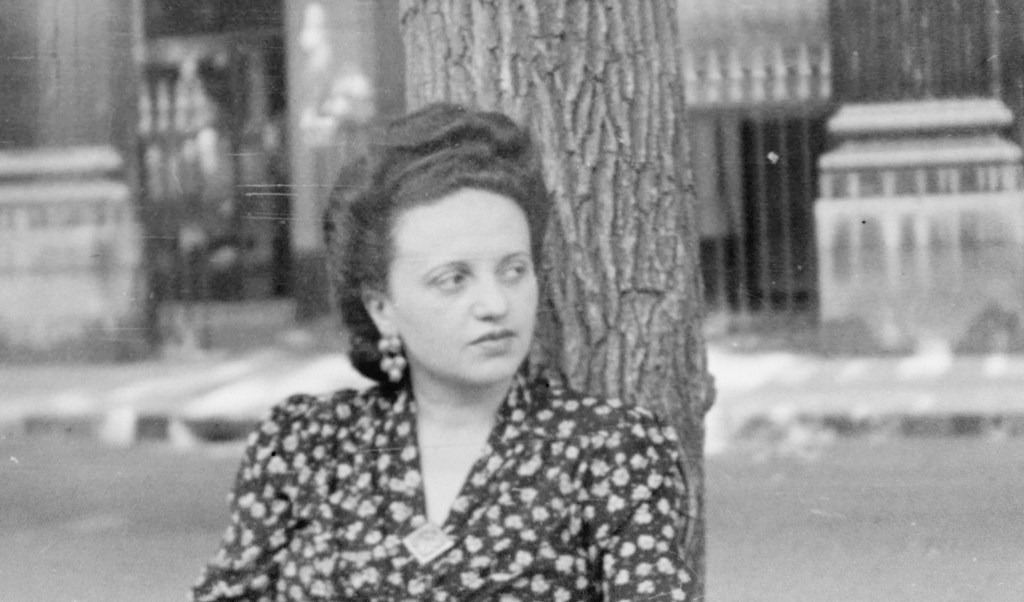
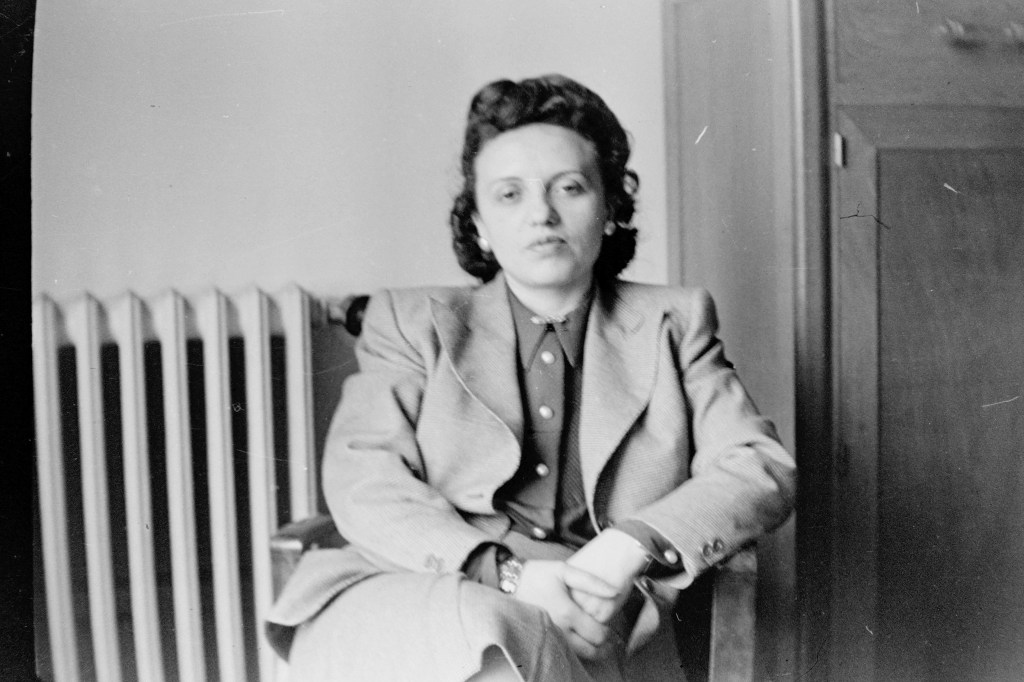
Now throughout that time Dicky lived in Paris — false French papers which were good enough for any German patrol stopping her but not good enough to fool a French policeman. And Dicky was hidden by non-Jewish friends. “Hidden” means she slept at one place, a few nights another place. These were Christians, French people, but also the girlfriend – a German communication soldier – girlfriend of that Bavarian aristocrat who had liberated Kalmus. And of course, sleeping in her quarters was an extremely safe place to be but you can imagine that it entailed a certain amount of risk for that girl.
So, Dicky survived. I have told you how she managed to evade the rafles [round-ups.] I didn’t tell you how she managed to live. Well, Kalmus had assembled a rather valuable collection of stamps and had also dealt in stamps before the war and for a time even during the war, and Dicky knew all the stamp dealers with whom her husband had dealt, and now and then she sold one of the more valuable stamps and financed her daily life. Well enough to be well-dressed and to eat. That was one way of surviving.
I met another man after the war — that is, after the liberation of Paris I only met that man — who was a Viennese Jew with a Viennese Jewish wife and a Viennese non-Jewish mistress, (the three of them lived together but that is another story,) and they lived through the Nazi occupation of Paris. He was a very impressive, tall, good-looking man and he did it with unmitigated chutzpah. He got himself some false papers to establish that he was born in Kolmar to account for his German accent in French, gave himself the name of Herr von Esch, or something like that, and had the splendid idea of buying his newspapers, a number of them, daily, at the newsstand in the Hôtel Majestic. Well, the Hôtel Majestic was the seat of the Feld gendarmerie (the Feld gendarmerie is the German equivalent of the Provost Marshall, of the MPs,) and since he was one of the few civilians walking in there — looked rather impressive, always very well-dressed, with a Homburg hat — people asked the newspaper stand owner, who is that? That’s Herr von Esch.
Well, he does establish a mysterious, obviously secret agent-type personality for himself and since there was great jealousy between the various branches of the German Secret Service (there were Gestapo, there were the SS, the Feld gendarmerie, there were the Abwehr-dins,) and they all competed with each other. As a matter of fact, there were three groups trying to steal pictures of world renown from various museums and private collections for three different clients. There was one group that tried to get pictures for the Hitler Museum, intended to be established in Linz; there was one group that collected for Goering; and finally, one that collected for Goebbels. Now they were just competing as much as the worst crooked dealers could, and the same kind of competition existed between secret services, so by creating a mysterious personality, Otto survived throughout this period in Paris. I cannot tell you how he made a living, I don’t know. Perhaps some of it may have been nothing to be proud of, perhaps otherwise; it’s not something I know. And he and his two women survived by that particular exercise of his wits.
Or look at what happened to my parents. I had left Paris for the United States in the middle of May or so, 1939 (no, it was a bit earlier. In ’39 but a bit earlier. I don’t remember the month,) and went to the States. My parents remained behind. There was no money. I was able to support them somehow while I was still here but that was not enough to leave them money, and with the help of some Austrian Socialist Committee they somehow survived [ed: see Letter 5 “Melodie Viennoise”,] and I eventually scraped together enough (making money in the States at the time was not very easy; it was in the middle of the Depression. That will be the subject of a separate story,) I eventually was able to send a check and apparently it must have been a very emotional moment for my parents. My mother died from a heart attack. I’m not suggesting that this heart attack was entirely a consequence of receiving a check, but she had angina pectoris and suffered many years from it. At that time, one did very little to even relieve it.
This however was after my father had returned from Finistère where he had been put by the French into a concentration camp. No, not the type of concentration camps they had in Germany; it wasn’t an extermination camp. It was a camp into which all Austrians, Germans were put regardless whether they were refugees who had fled Hitler, or Nazis who were sent ahead to be a Fifth Column in France. The French took them all together and stuck ‘em into concentration camps.
There was a little mishap. My mother had the – this happened after the war broke out, the real war (the Sitzkrieg was over; that was the period where the French were sitting in the Maginot line, certain that this would hold the Germans off, and after that it got serious.) So the, all the refugees were — the non-French without permission to live in France — were put together.
 Victor Gruder