Above you will find a digital copy of Cassette 8A, recorded by Victor Gruder. What follows below is our best efforts at transcribing the contents of the recording. Occasionally, an informal translation or editorial aside is inserted in square brackets ([ ]) for clarity or context. Anything underlined is a hyperlink. As with the title of each “Letter”, they are our addition, and we deserve all blame for incorrect statements or assumptions.
……………..
….once again, there was a long interruption. Mommy was in the hospital for her rheumatism test. We had guests. I’m starting to work again. There has been a long interval since the last tape, and it caused me, once more, to listen to what I have said so, as to retrouver le fil [pick up where I left off], I did listen. However, during the previous interruptions, they have served as pretexts for insertion of correction, post scripta, addenda. We even had the time capsule. The one thing we haven’t had is an intermezzo. Here is an intermezzo. Not necessarily for the purpose of comic relief, but I want to say something totally out of context. Something not to do with what we’ve been talking about.
I’m intrigued by the phenomenon of memory. We know about that marvelous computer we have in our heads. We know about associations that trigger a memory. But what is it that makes certain, in themselves insignificant, events, memorable and, I feel, events which are totally disproportionate to the intensity of the memory? We know that, broadly speaking, there are people who perceive – auditive types, visual types, the latter far outnumbering the former. I remember when we were taught that in school, this distinction between types of perception, that it was illustrated by the fact that very few writers seemed to be auditive types, and Romain Rolland was cited as an example. In Romain Rolland books, you always hear the rain, and you hear sounds. While more often, you see the raindrops in a book. You are made to see raindrops running down a window, or what have you. More the visual kind. Well, I found, to my surprise, that I have segments of memory where all five senses played. Not at the same time. An example, for each one of them.
One particular auditive experience comes to mind because I have total recall of the situation, of the time, of the place, and it was a long time ago. I was with my mother on a vacation in Arbey.
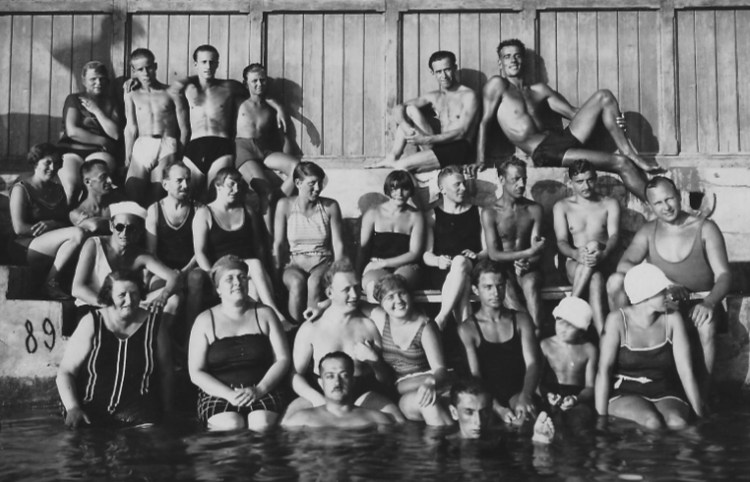
That’s in Yugoslavia, an island – no, not an island. Anyway, I don’t remember Arbey but I do remember a balcony in the hotel, overlooking the water. A very beautiful sight. And I also remember having heard a melody which I had heard for the first time. I was about, I would say, thirteen or so, and it was a haunting melody. A very simple one. I’ll play it for you. It is a simple melody. It’s a Brahms waltz. What you are hearing is a 78 recording. The violin is played by Jacques Thibaud and, when I heard it, at the time, it was played by Bronislaw Huberman. It was the first time I heard this Brahms waltz. It was neither the greatest invention of Brahms – it’s a very simple melody – but it haunted me and, apparently, also the person who played it because he must have played it five, six times, over and over again. And I was delighted and terribly anxious to know what it was so that I could, back in Vienna, rush out and get it, buy the record, what have you. [ed: music plays]
Now, what was it that made this particular melody stick in my mind? I not only remember when I heard it, but I remember the impression it made. It moved me; it moved me to tears. It’s an event, an experience which is so clear, photographically clear in my mind. Now, what on earth made this piece of music stick out and remain engraved in my memory? Incidentally, I did seek out the neighbor who played it in the hotel and learned from him what it was and who played the violin.
Another auditive experience. It’s a little more intellectual. It has to do with you. You were, at the time — I’m not quite sure — about four years, four or five years old. And I heard you hum a melody. [ed: music plays] This is no less but the Bach Concerto for violin and oboe. You know, to our doubt and know something about music, you consider Bach to be a difficult, complicated, no — not complicated, but a difficult composer. It’s heavy music. And the sudden realization that you had picked that up – I must have played it very frequently – and you picked it up, brought home for the first time the fact that to children, nothing is heavy or easy. It just gets absorbed as by a sponge. It made a very deep and profound impression on me that you picked that up. It made a mixture of pleasure that a love and liking for music can be evoked, can be instilled by the simple process of exposing a young mind to it.
Talking about auditive experiences triggers the thought of another one which is not a thought about memory but is an auditive experience I remember because it was so unusual and it puzzles me still today, how this particular experience was triggered, how this came about. Mommy and I were in Vienna, somewhere, 1950 or so. We wanted to go to the opera, and I mostly wanted Mommy to hear and meet Maria Reining but we couldn’t get tickets so, we went to another opera. And it was “The Magic Flute”, an opera I love, which I consider almost my favorite Mozart opera, and there were a bunch of singers whose names I didn’t know. And then there appeared a very beautiful looking Pamina who started singing, and as she opened her mouth and the first sounds came out, the tears started rolling down my cheeks. Absolutely helpless to do anything against it. Every time she sang, I cried. I shouldn’t call it crying because I wasn’t in the mood of crying. I wasn’t sad or anything, it just triggered something in my tear glands. I felt terribly embarrassed because I was afraid people next to me were going to notice it, a grownup man and way past the age in which one tries to impress one’s neighbors with one’s knowledge of music or one’s emotions. I was terribly embarrassed but couldn’t help the flow, couldn’t stop it.
We, later, were introduced to that singer by Heinrich Hollreiser, who was the conductor in Düsseldorf. While we were there, he was frequently in our house, and he had just been hired by the Vienna Opera. We met him in the intermission, accidentally, and I told him about, who is this absolutely fantastic Pamina? And told him that I hadn’t — a voice didn’t have that kind of impact on me since I heard Lotte Lenya the first time. He said that it was Lisa Della Casa; he was very pleased that I like her so much because he had just invited her to sing the soprano part in the Ninth Symphony, Ninth Beethoven, which he was playing for his goodbye concert in Düsseldorf. Would I want to meet her? So, we went backstage, and we met Lisa Della Casa, a beautiful, Italian-looking woman with a resounding Italian name. And it came as an absolute shock that her speaking voice was a vulgar Viennese dialect-type voice, which sort of kept me off but, nevertheless, whenever I heard her singing, from that day on, I was impressed but I no longer cried. Now, what is the physiological process which causes the brain to receive sound and trigger tear glands? I have no explanation for it. In fact, I haven’t researched the matter very deeply, but it was a unique experience.
There was another trick auditive memory played on me. As a matter of fact, I may have told you this story in connection with musical evenings. But at the risk of repeating it, Mommy and I were at a concert in Düsseldorf, late 40s. The Wiener Symphoniker played under a conductor I didn’t particularly like. (I think it must have been Clemens Krauss or Karajan or somebody.) And, before the intermission, they played a work in which the flute was rather prominent. And I said to Mommy, “I haven’t heard such a sweet sound, such a sweet tone, on the flute, since Camillo Wanausek,” who was one of the people who had frequently been in our place [ed: Viktor’s notebooks indicate that Wanausek attended and performed at a number of the Gruder home concerts. See Letter 6 “Viennese Refugees”.] And, having my memory triggered to the name which I hadn’t thought of in many, many years, I went backstage and introduced myself to a member of the orchestra and said, “By any chance, does the name Camillo Wanausek mean anything to you? It was somebody I know who I haven’t been in touch with for many years. Any idea whether he exists?” “Yes, he is our flutist.” It’s funny that the memory should operate to recognize the sound of an instrument. Yes, of course we talked to each other and had much to say to each other. I told him that I had recognized him. He must have taken it as a mere matter of politeness or what have you. But that’s anticlimactic.
To something else. I told you before that memory works, as far as I’m concerned, for other sensory experiences. And I’m remembering one that has to do with taste. Once, with a then-current girlfriend in Vienna, went to eat with her in a restaurant, the name of which I no longer know but I could find it. It was a good, small restaurant with tables outside behind some greenery and we ordered pheasant. The taste of that pheasant I remember to this day and, interestingly enough, I have never since eaten a pheasant as good as that or tasting like this one, but I know exactly what it tasted like. I do remember the circumstances and the place. Here, that goes for taste.
Another sensory experience, remembered sensory experience, is the nose. When I thought of the Opera, in which as you know I spent much time, during intermission one went to the promenoir, and a beautiful hall, Ballsaal [ballroom] if you wish, at the end of which was a bar and at this bar they sold champagne in glasses, a particular pâtisserie from Demel which, when I was in the chips, I treated myself to. But that’s not the point. The point is that there was a certain aroma, a certain perfume in the air. I cannot define it. It was a mixture of smoke – because one could smoke cigarettes then – of alcohol, I presume. Let’s not define it. It was a perfume peculiar to that particular buffet. And when I was elsewhere and I thought of the Opera as a building, the association was immediately with that perfume, with that smell. And as I went to the Opera years later, I found the same smell. So, you can remember a smell.
Visual memory is nothing special. Most people have it. One comes to mind. I, once, was in a museum. It was not in Paris. I no longer remember the museum. I was alone. There were few people. You know there were times when museums were fairly empty. This was one of those times and, as I turn a corner, I see a woman standing in front of a picture. A young lady, perhaps, late 20s, 30 or so. I saw her profile and it intrigued me. I arranged to see her en face, and it took my breath away. She was one of the most lovely faces I have ever seen. I must have stared because she sort of turned away, expecting perhaps that I would accost her. I had no such intention. I didn’t follow her. It was an experience which lasted, perhaps, a minute. I was, just, absolutely breathless by the beauty of that face. And what I find interesting about it is that if I could draw, I could draw this face today, thirty years later. I never talked to the woman, nothing. There was no relationship. I didn’t even particularly care to meet her. It was just, if I would have had the guts, I would have told her, “I just want to look at your face.” You can’t do that, unfortunately, but that sticks in my memory.
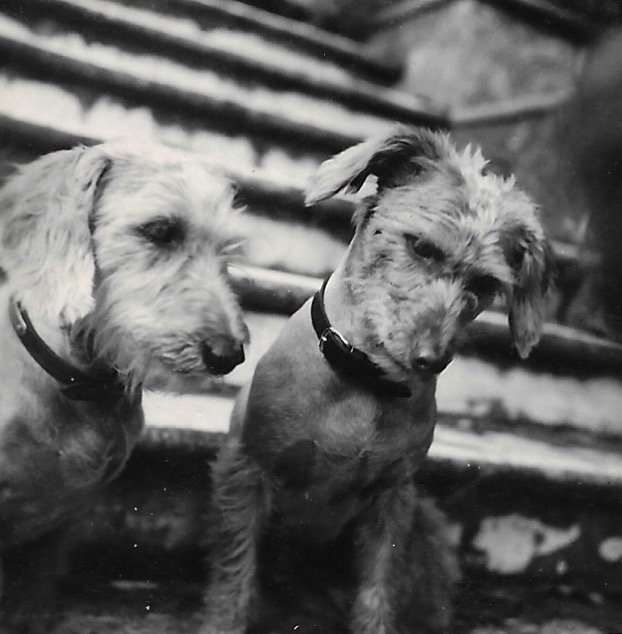
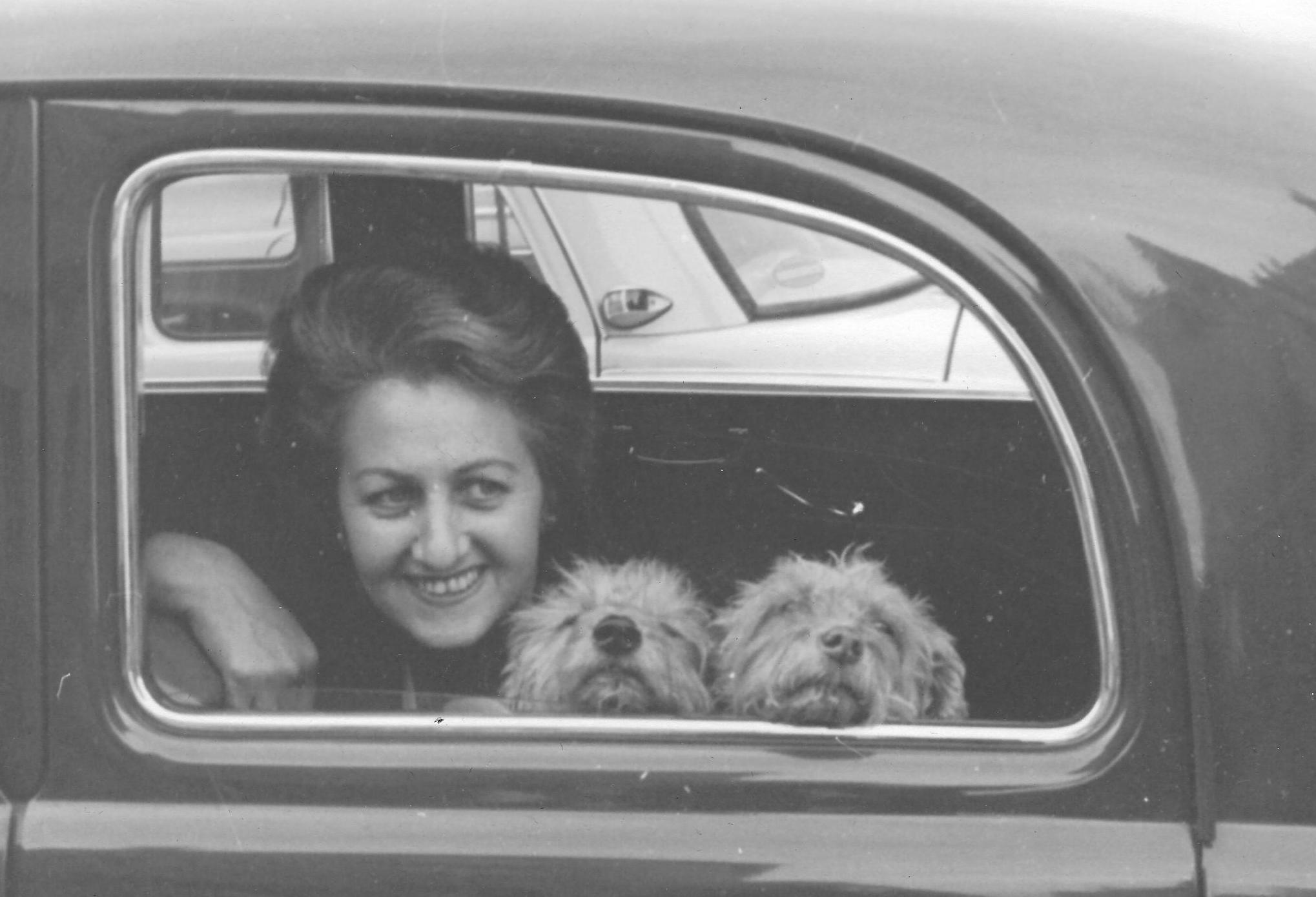
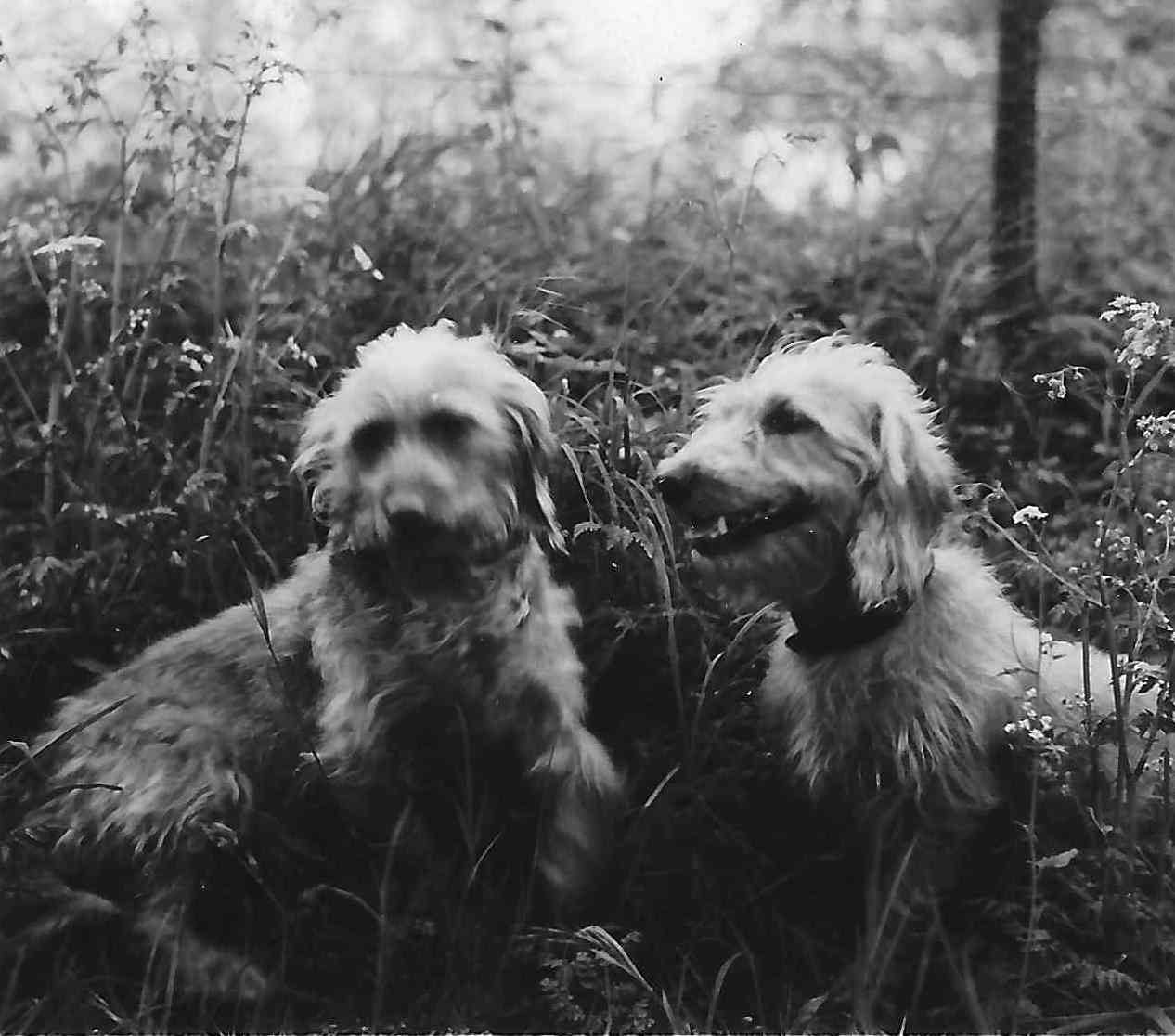
Lastly, there is memory due to touch, triggered by remembered feeling upon touching. Actually, it’s very easy to understand that blind people have such a memory because seeing people don’t register it that way, but I do remember clearly, so that I could recreate it in my mind, of course, the feel of stroking our dogs – Graupi or Dinah. And it’s something that I have the feeling I remember.
After this excursion into a totally unrelated field, or perhaps not so totally unrelated because the whole project of talking to you is a long string of trying to remember. Incidentally, I am very pleased to notice that I have no great difficulties except there, once in a while, there is a hole. Now, for instance, I told you that when I received the urn with the ashes of my father in the Gare de l’Est in Paris, that I was alone, and I mentioned that I don’t know why Mommy wasn’t with me. [ed: see Letter 7 “The Harshness of Life in Postwar Germany”]. Now Mommy was very indignant when she heard this and assured me that she was, by all means, with me in Paris. And yet, I seem to remember clearly that incident with the taxi driver who didn’t want me to be alone. I wouldn’t have been alone if Mommy had been with me. The only explanation I have, is that she had come with me to Paris but that I wanted to spare her the trip to pick up a box. I knew I had to bring that box to the Père Lachaise and leave it there until it was, more ceremoniously, put into the place I had rented. And perhaps I had persuaded her not to come to the railroad station with me because she is absolutely certain that we went to Paris together.
Well, back to Bad Schwalbach and your earliest days. We lived in a house that had been assigned to us. A small house. It wasn’t the one of which you have seen many pictures, the very pretty one we lived in later. It was a small house, up on a hill, with a beautiful view.
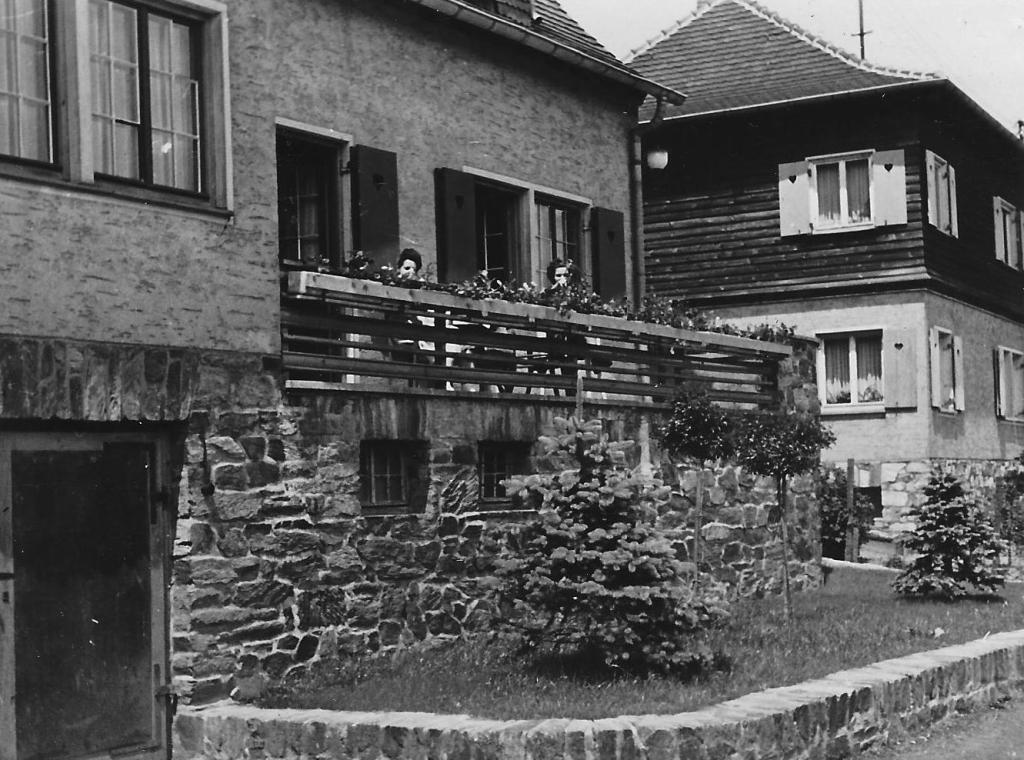
And we went to the military hospital in Wiesbaden, to the gynecological ward. And there was a very unpleasant doctor who predicted that Mommy would have difficulty with the birth and that a Caesarean might be necessary, which he couldn’t do because he was alone and then when the time comes, she would have to go to Frankfurt. Well, we were prepared for this and, one day, Mommy informed me — she was highly pregnant, very big — and one day she told me she feels that the time has come. I think it was very early in the morning (at least in my memory and Mommy might remember that better,) and said it’s time to go to the hospital. I drove her into Wiesbaden where they transferred Mommy into an ambulance. She got into the ambulance. I could not go in the ambulance and followed with our car, which meant that Mommy was rattled in an old-fashioned, converted, military vehicle, converted into an ambulance — had a very unpleasant ride to Frankfurt — while I sat comfortable in the car, driving stupidly behind it. As we arrived in the hospital in Frankfurt, out came two stretcher bearers and insisted that Mommy has to go on a stretcher. She said, “My God. I walked to the hospital. I can walk in there.” Nothing doing. The regulations say that if you arrive at the hospital with an ambulance, you have to be carried in. So, laughingly, Mommy laid down on a stretcher and was carried in.
And there she was. She was there for more than a week. They tried to induce it, because she was right – the time had come. They gave her tests, and nothing happened. They made her walk. They gave her laxatives. They tried by all means to induce birth, and nothing happened. And, finally, there were some visiting doctors from the States who examined her, and by God, they discharged her from the hospital and said to come back when labor begins because nothing had happened, there was nothing going to happen immediately. And we took off, and I remember we made a long drive through the woods. This is the end of May, the beginning of June. No, I beg your pardon. What am I saying? It was June, end of June. We went deliberately over bad roads just to shake you up into coming into this world.
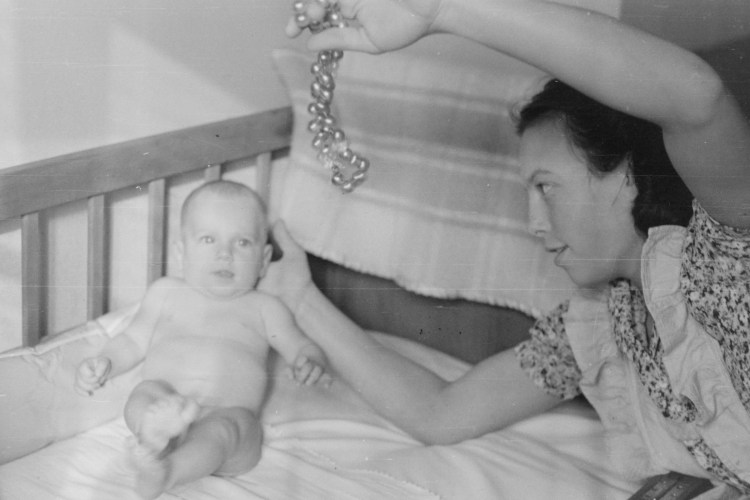
Well, eventually, the time did come. Funny, I do not now recollect our drive to the hospital when Mommy felt that the time had come, but at any rate, you were born in a relatively short time, and I leave it to Mommy to tell you the details of that particular birth. And she may even remember the exact hour, if ever you need to have a horoscope in which one, allegedly, needs the exact hour of birth. I just received instructions from Mommy, or rather information from her: we went directly from Bad Schwalbach to Frankfurt in our own car, at four o’clock in the morning, when Mommy felt that the time had come and she started to be in labor. We arrived at the hospital at six o’clock and, she just said, labor immediately stopped. And again, nothing happened. At eleven-thirty, the doctors looked in on her. They said, “We are now going to eat. Nothing is going to happen.” And, sure enough, as soon as the doctors were all gone, at high noon, there you came. Well, they did get the doctors. They were present.

Now your Aunt Lyd had come to be present at the event. Not to the hospital. She was in Bad Schwalbach, staying with us and we had made arrangements for a nurse maid. And you came into this world to the great joy of the family but also the whole headquarters that had helped sweat out that long pregnancy, that long overdue pregnancy. In fact, there was one unkind man who asked Mommy whether she was certain that she wasn’t an elephant, elephants having a gestation period of two years, I believe.
Well, in about March 1949 we moved from the smaller house to the big one, that lovely house which had been built as a wedding present by the owner and patent-holder of the German version of the Band-Aid, a very rich man who built it for his son. It was pink. It was called The Little Castle.
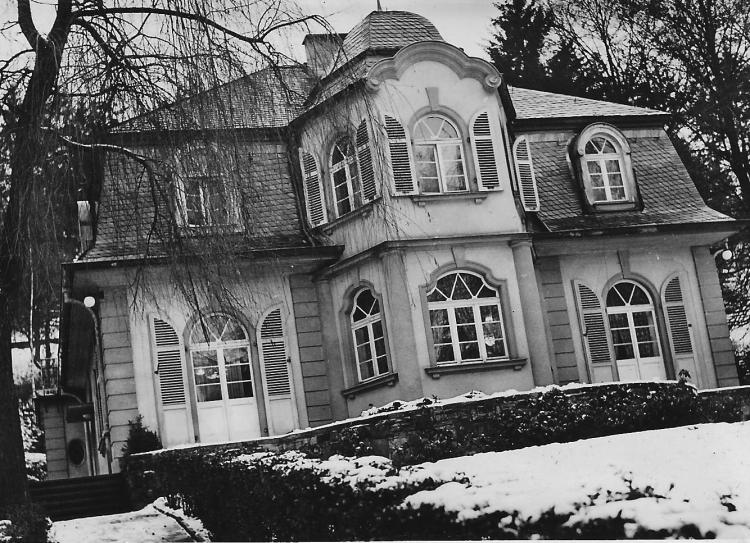
As a matter of fact, it took some doing to get that house — not very interesting to tell — but eventually we were assigned that house and had very happy days in it, as some films I took at the time testify. In fact, one of the films is of your birthday party when you were one year old.
You know, thinking back, when you consider that today, it is difficult to get a cleaning woman for a few hours a day, just trying to assess what we had by way of help at the time. There was Lenchen, the cook.

There was a succession of, I believe, one or two nursemaids before Irmy came aboard — one of them a trained nurse who, however, was trained during the Nazi period and behaved more like a sergeant, whom we fired very quickly. It may have been only one, and then Irmy came.
In addition to that, there was a washer woman, an East German who came, I think, once a week. There was a gardener. There was Böhm, the driver. And, I believe, we paid out of — I know that we paid Böhm ourselves. But the rest was paid by the, out of, Occupation Costs. Let me explain that. “Occupation” meant that the German government paid the owners of the houses a rent, and the help to which we were entitled, depending on rank, size of the house, God knows what, all this were Occupation Costs. We are before the Marshall Plan, before the time when the U.S. poured money into Germany. This was a time when these people were paid by the Land government. Of course, the food, we supplied, and it was apparently a desirable job to work for Americans because people ate well, which they couldn’t do on – I explained that before — when they had to buy it on the German market.
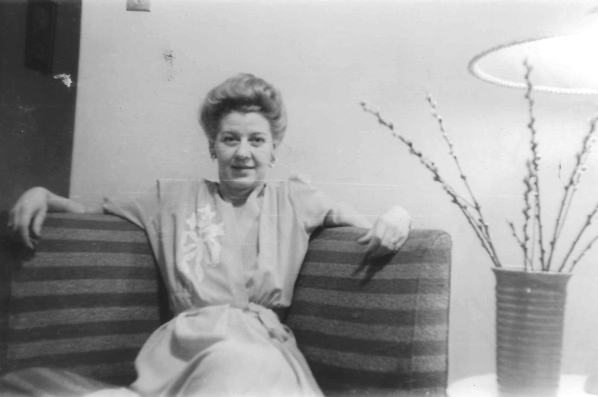
We had a lively social life. Many visitors, Americans, people we have kept on seeing since, such as Guggi, Marianne – oh yeah, I better tell you about Marianne. She had been a girlfriend of a friend of ours. That friend, by the name of Harry Frohman, had a wife and that wife shared our apartment in New York with Mommy in my absence during the war.
Harry Frohman was a soldier as I was. He had been a famous man in Germany before because he has founded a musical quartet, the Comedian Harmonists, which was a then-novel thing where Harry’s specialty was imitating instruments with his voice. While the other three were singing, he made the, he did the instrumentation by imitating the various instruments. And they were rather famous in Germany before Hitler and, after Hitler, when they – they were all Jews — had to leave, they still were playing in Paris (I heard them once in Paris,) and they took headquarters in Vienna, and this is where we had met.
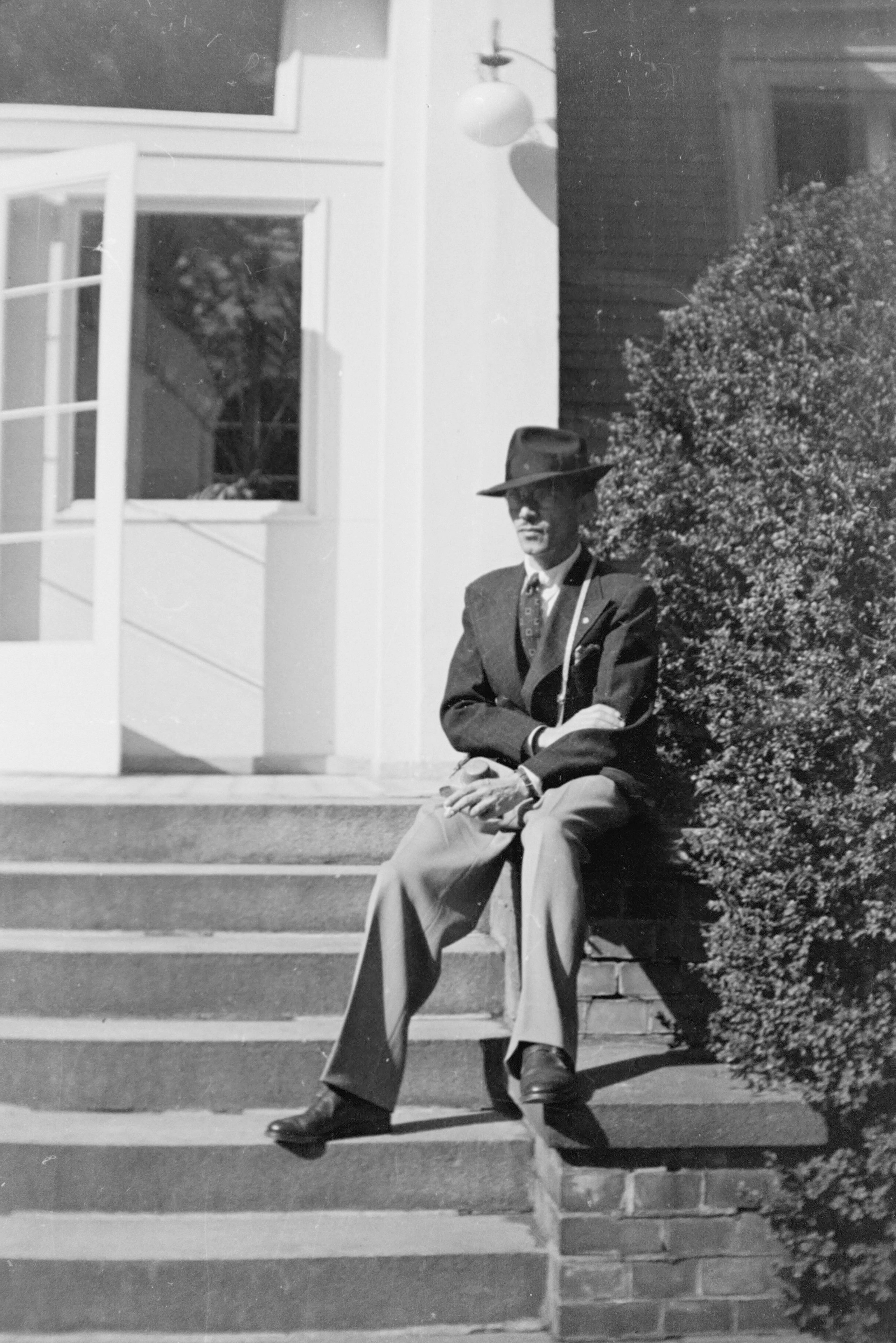
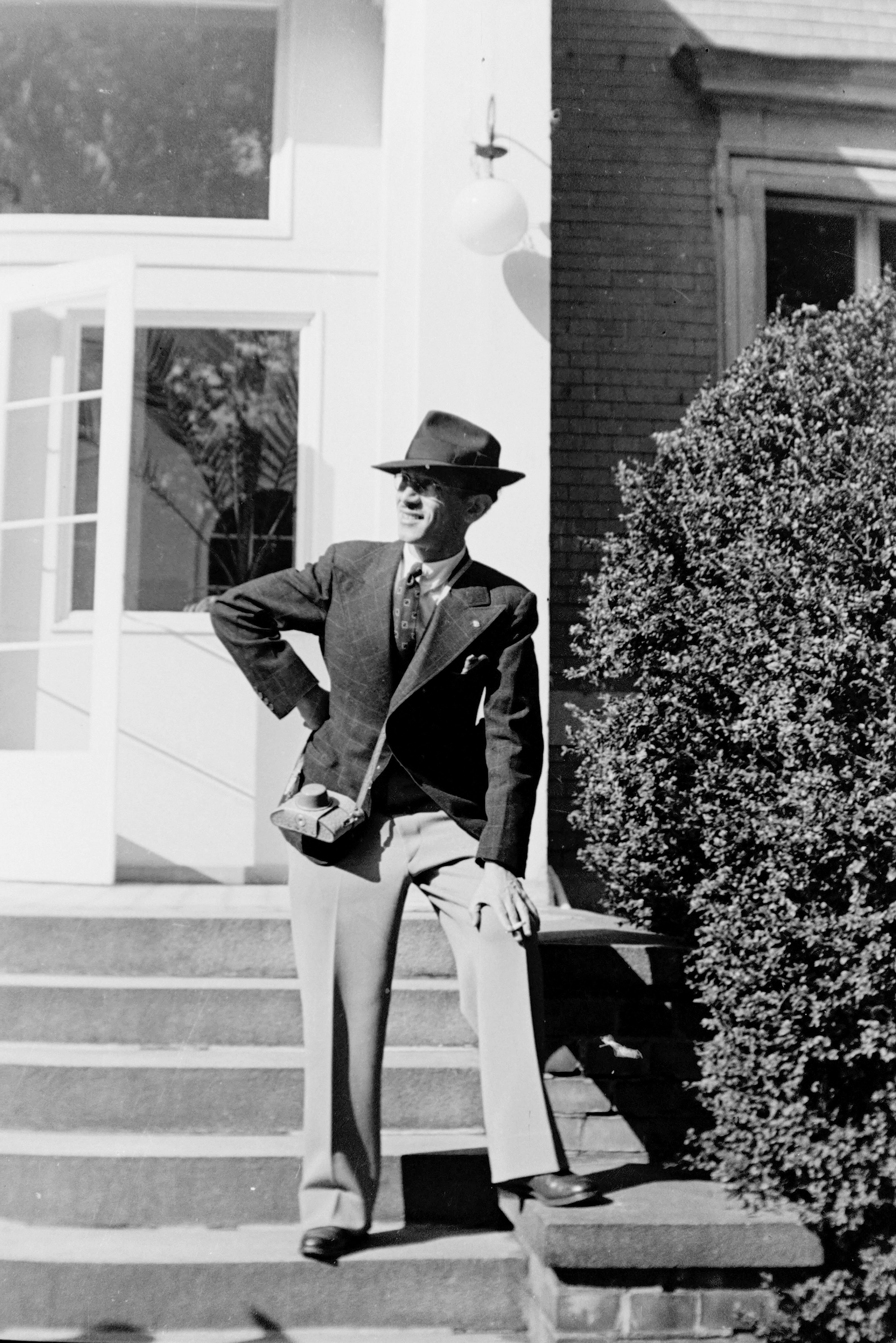
Actually, I had met Mrs. Frohman, “Maus,” first, before I met her husband. And a friendship developed. Now during the war, or rather, after the end of it, in Berlin, Harry Frohman was connected with the theater officer, and he was connected with RIAS-Berlin, the radio station run in the American sector in Berlin where Marianne worked, and she was his girlfriend. And Harry got involved with a horrible woman who grabbed him for strictly reasons of advancement, and he became infatuated with her, and he dropped Marianne, who was very unhappy. And since she was unhappy in Berlin, and I generally felt that Berlin was no place to be, I got her a job at the radio in Hessen. I was friendly with the director of that station and helped her come to Wiesbaden. I believe I drove her from Berlin to Wiesbaden, where she then took over the station. [ed: Marianne eventually moved to Brasil where she married and lived until her husband’s death. She then returned to Europe, always staying in frequent contact with the Gruders.]
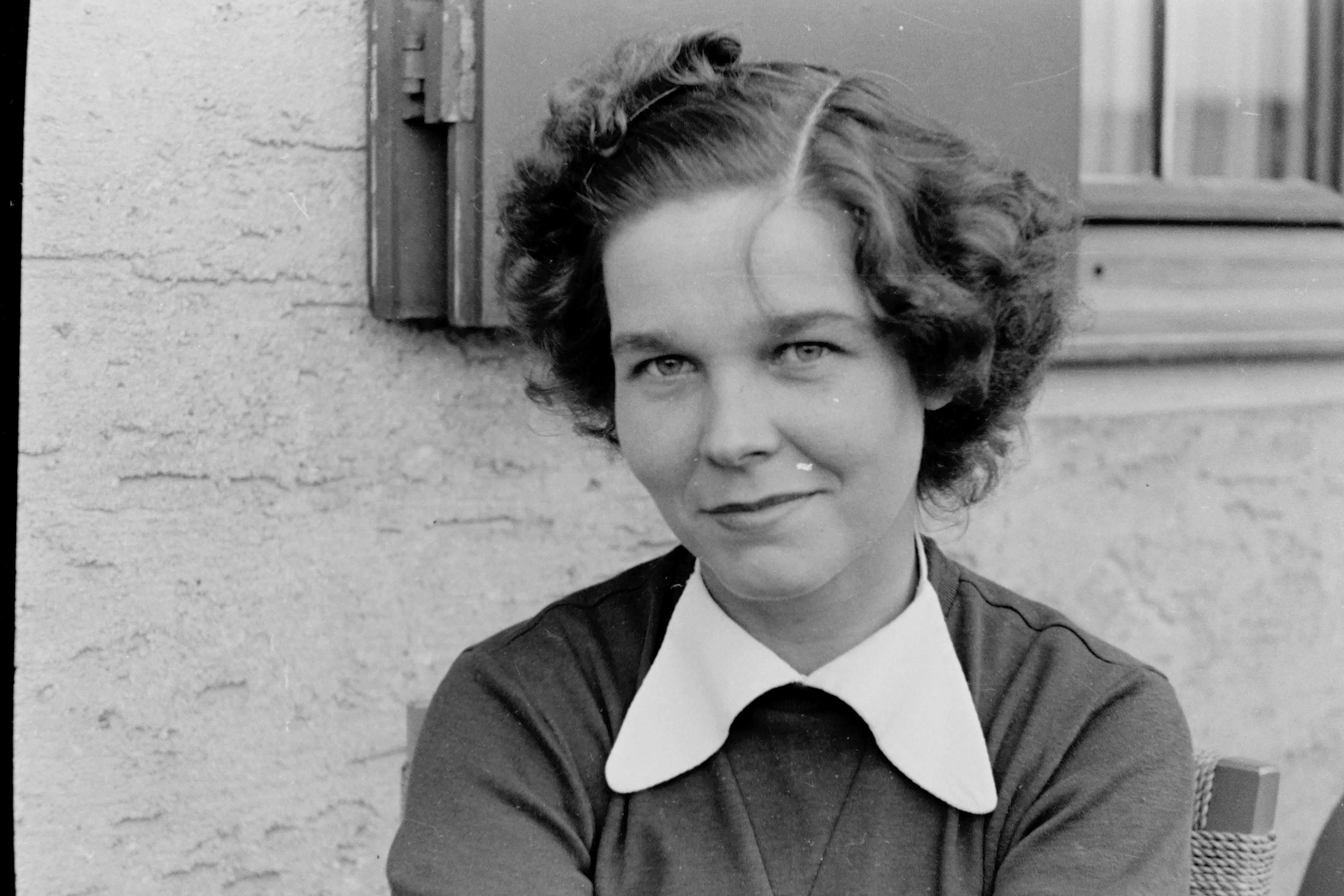

The station was, actually, in — the Hessischer Rundfunk — was actually located in Frankfurt, even today, but they opened a studio in Wiesbaden, and she was put in charge of it. And later I recorded a lot in this station. That’s also an interesting story. It has to do with my job.
We had a Speaker of Military Government. That’s somebody who, I think three times a week, for thirty minutes, spoke for the German radio station, giving the point of view of military government on various subjects. And our speaker was an American by the name of [Atsett?]. He sported Texan dress. That is, he wore pyrotechnical ties, yellow shoes with a dark suit and spoke flawless, accent-free English. But he also spoke German, although with a very strong American accent. Well, it turned out that Mr. [Atsett?] had family in Germany and his family relations were an embarrassment to military government because one of his sisters had been married to a Nazi, to an SS general. One of his brothers was very active in Nazi politics. And Mr. [Atsett?] was unceremoniously dropped and returned to the United States.
They were looking now for a replacement and the Deputy Military Governor of Hesse, Frank Sheehan, interviewed a number of people. George Fleischer, one of them;
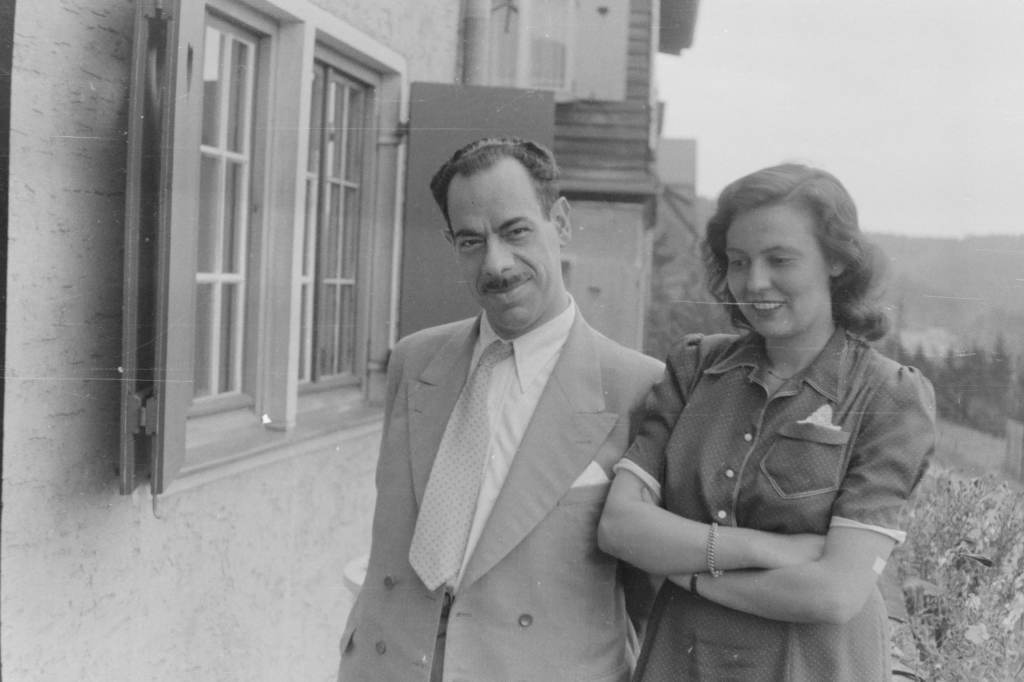
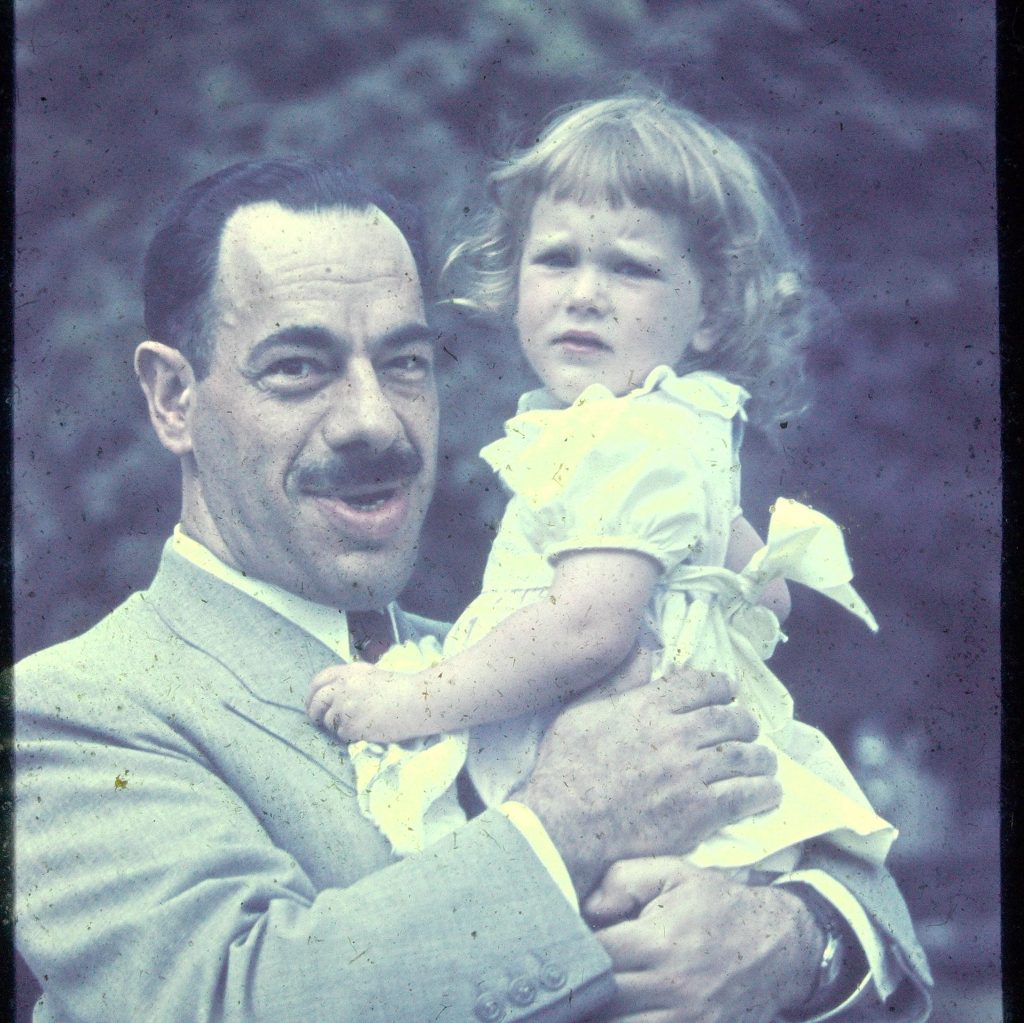
myself; other people who spoke German; and I was selected.
I made one condition, that I would not pretend an American accent. I would speak Hochdeutsch, and by speaking Hochdeutsch in Germany, strangely enough, you sound like a foreigner, because every German speaks with a regional intonation and Germans are very good at telling where somebody is from, strictly by his intonation. It’s a little bit like Americans can do that too. While it was — in Vienna one spoke, actually, two different types of German. One spoke the everyday German; this is the way Aunt Lyd sounds or Karli speaks with a Viennese dialect. But even without the dialect, the intonation is Viennese. That’s how we spoke in everyday life. And in the theater, in the Burgtheater, one spoke theater German — that was, Hochdeutsch with no regional intonation. That is also the way an educated person spoke as a public speaker, before a court, or holding a lecture. If it wasn’t a political speech in which somebody wanted to be elected (and then of course, you turned on the Viennese dialect,) depending on the public, you spoke Hochdeutsch, and that means a dialect-free, accent-free German. Strangely enough, while it may have, and it must have existed in German stage — in fact, I know it existed because I had heard German classical plays played in Germany and they were accent free but, particularly in the theater. In everyday life you spoke with a regional accent.
Suffice it to say that it was accepted that I should speak as I saw fit, because I had been told by the radio people that Mr. [Atsett?]’s strong American accent miraculously improved as he went along. After a few minutes he, sort of, forgot about his accent. It’s very difficult to maintain an accent. An actor is trained to do this, but an everyday person has great difficulty to keep it up, particularly when you get involved in what you are saying rather than how you are saying it. So, once a week I went there to record; the manuscripts were given me from the various divisions, and it was mostly excruciatingly dull stuff. You know, bureaucrats writing speeches, was not very interesting. What was interesting, that I usually had the radio on in the car when I went home and, since I had recorded my spiel, three, four, five times – no, for three, four, five broadcasts at one time, I forgot about it afterwards. And once I was in the car going home and I had the radio on, and I listened to a guy speaking about something that wasn’t very interesting, but it sounded strangely familiar. Eventually I recognized it, as it was I, speaking.
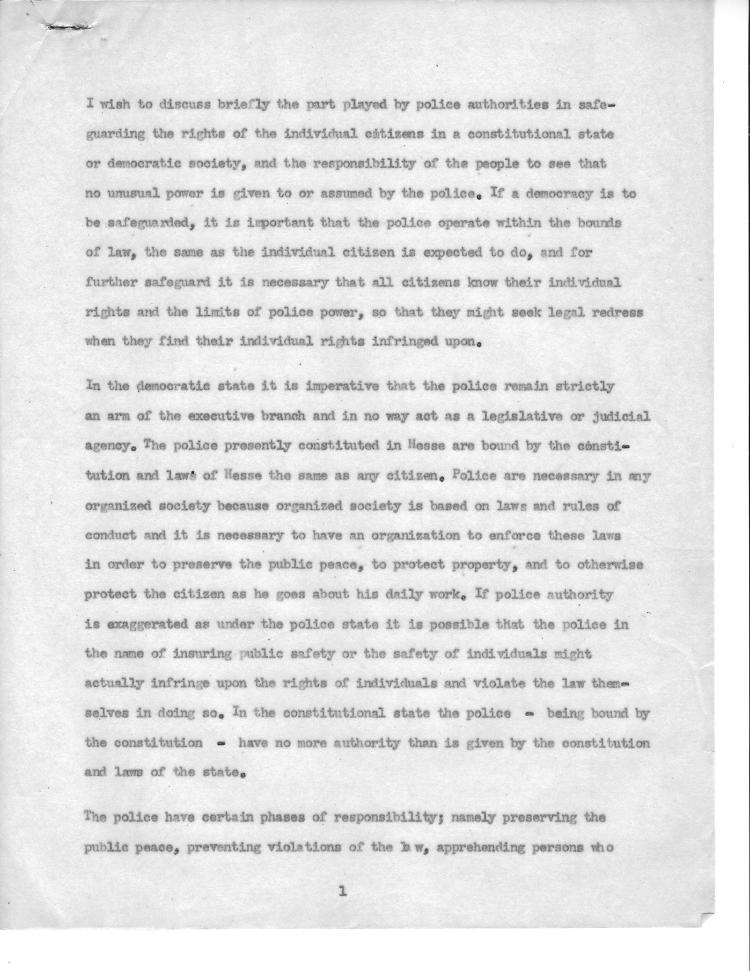
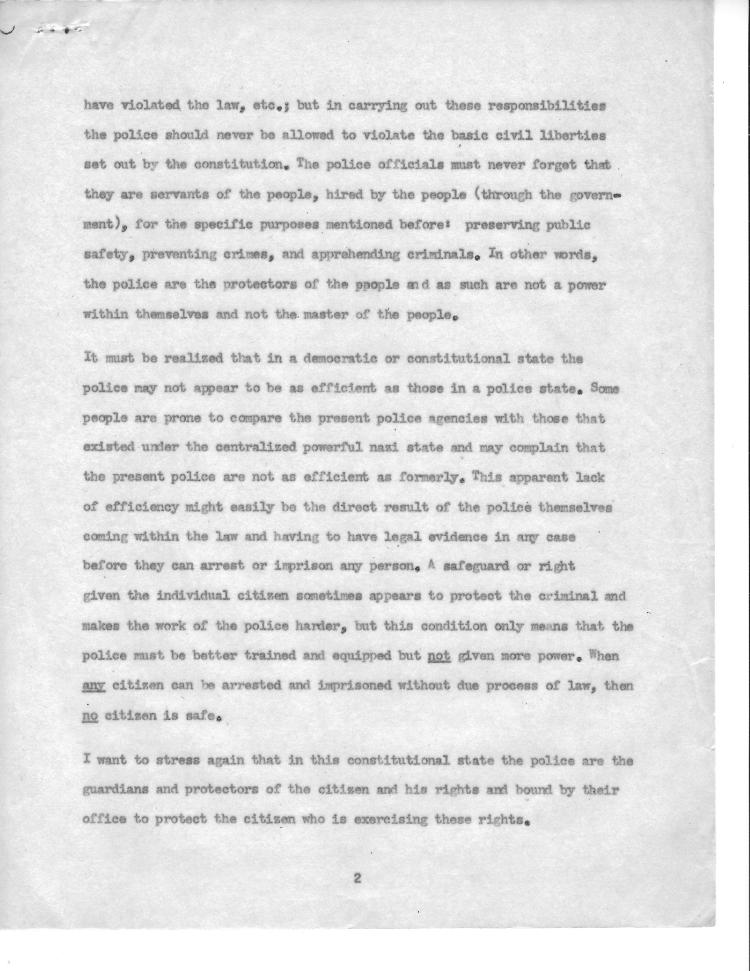
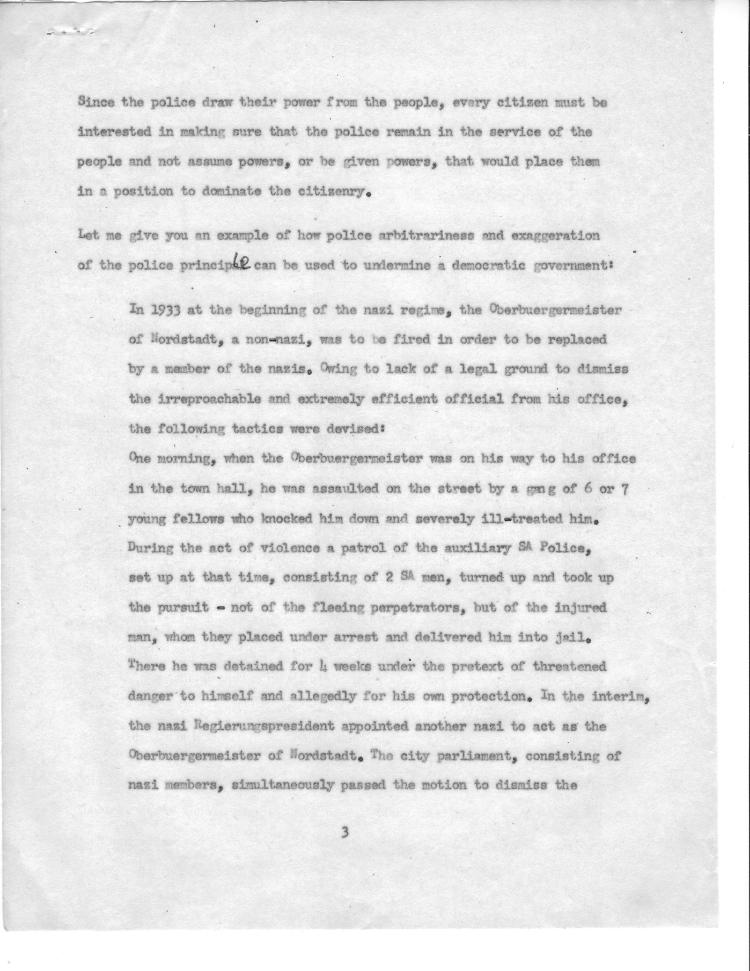
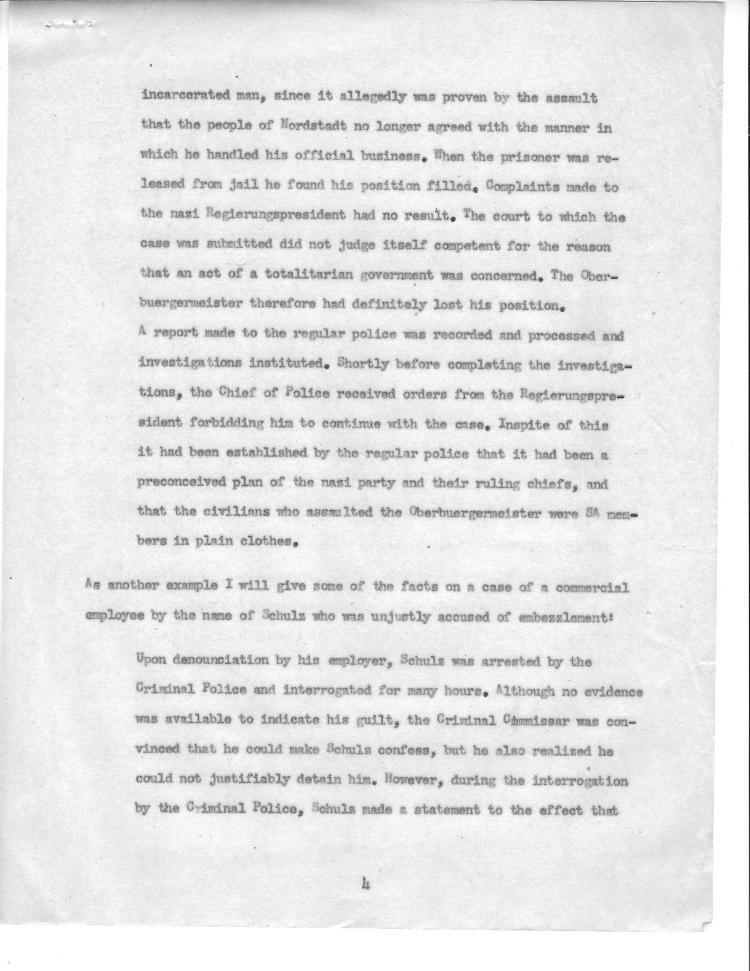
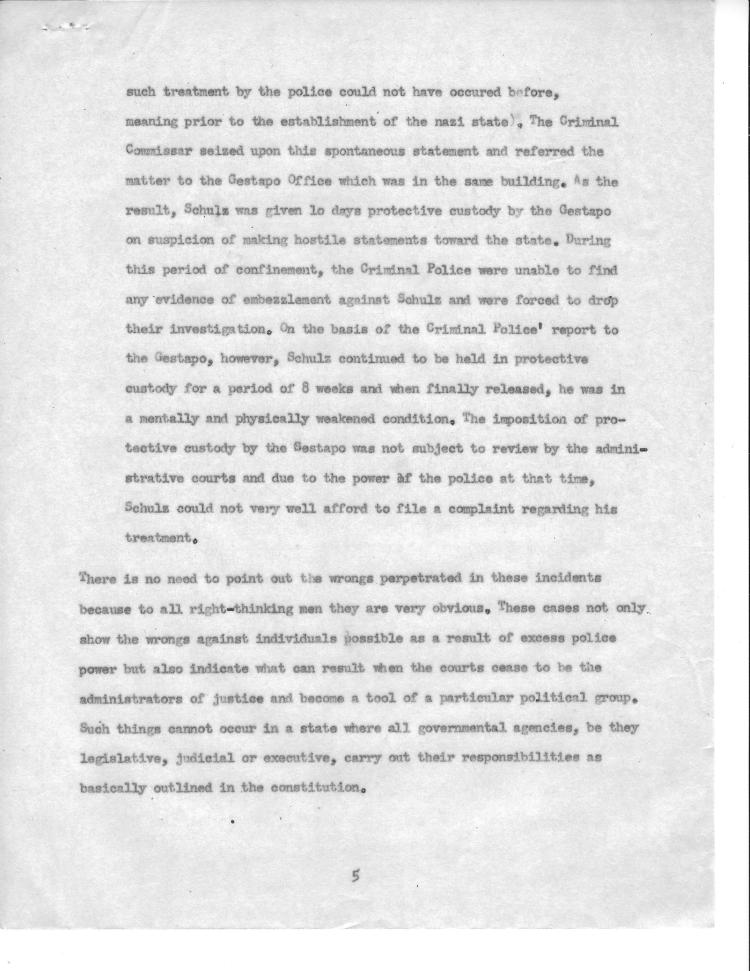
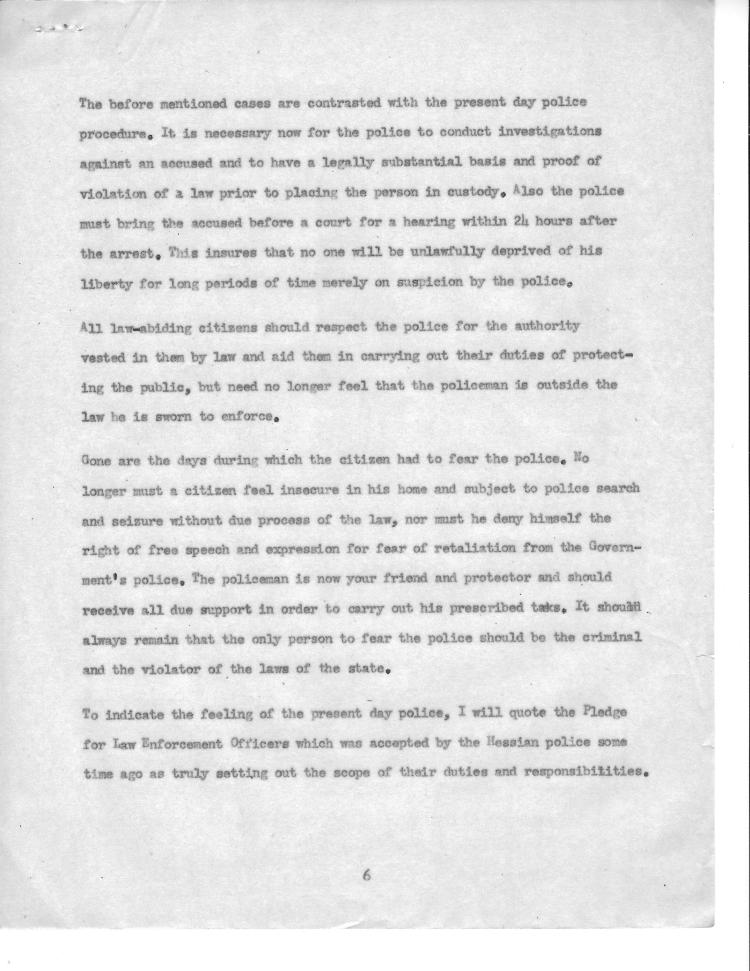
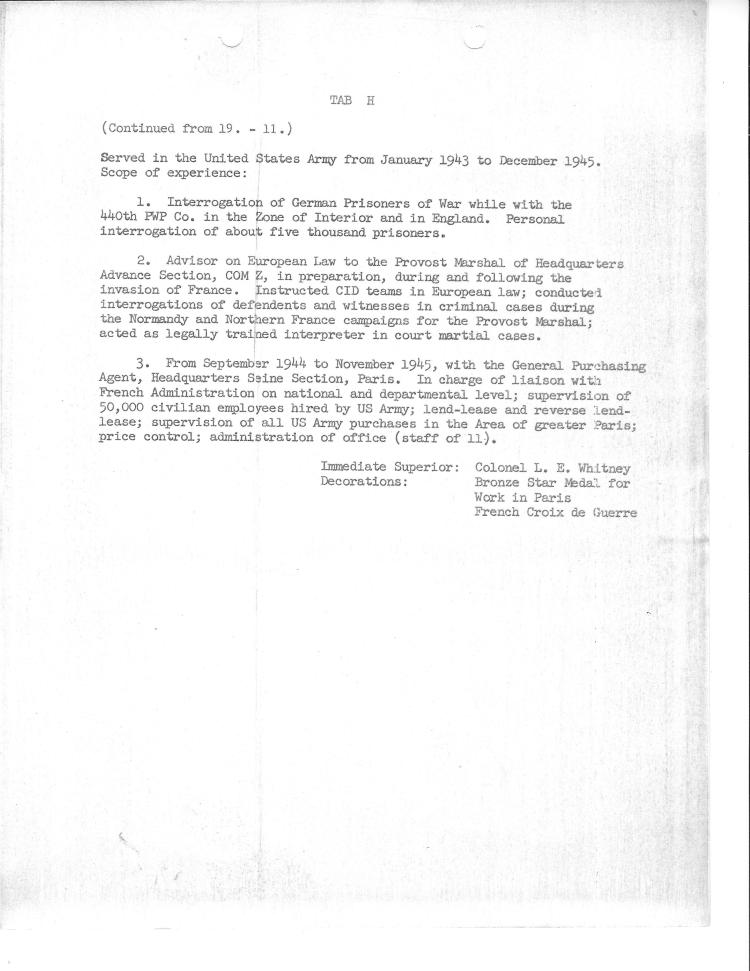
I did a lot of talking in my job and part of it was fascinatingly interesting. You know, we were a very enthusiastic bunch in military government. The idea of educating people to the democratic process was an exciting one, and we set about it with no cynicism and lots of enthusiasm. And particularly one thing became a crusade, in which I played a major role. The subject was Gewerbefreiheit in German. In English: “Freedom from Licensing.” That requires an explanation. There was not one occupation, not one field of activity, of human activity, in Germany which wasn’t subject to a license. That is, in order to do that job, you had to be licensed by somebody. And to give you extreme cases, there was a poor woman from East Germany, a refugee from East Germany, who repaired men’s underwear on her sewing machine, and she was actually called before a court because she exercised this profession without a license.
 Victor Gruder