Above you will find a digital copy of Cassette 9A, recorded by Victor Gruder. What follows below is our best efforts at transcribing the contents of the recording. Occasionally, an informal translation or editorial aside is inserted in square brackets ([ ]) for clarity or context. Anything underlined is a hyperlink. As with the title of each “Letter”, they are our addition, and we deserve all blame for incorrect statements or assumptions.
………………
Max Lorenz was not only a tenor — he was the reigning Wagner tenor of the time, that is by rights. And he had been a protégé of Goering. Goering not only protected him, or rather protected not only him, but also his Jewish wife. She went unscathed through the Nazi period, probably living discreetly. Now, by the time I met the couple, the situation had been reversed. As a protégé of Goering, you can imagine that Mr. Lorenz was of course subject to de-Nazification procedures in Germany. There were some assumptions that he must have been a Nazi. On the other hand, he had this Jewish wife who, by definition, was a persecutee and received double rations in Austria. They lived in Vienna, carefully, which was a little less in the limelight than in Germany. Well, we assembled after the performance, in Mr. Lorenz’s apartment near the opera. And you probably know that opera singers never eat before the performance, and the physical exertion is such that they lose up to three, four pounds during a performance. So, after the performance they eat, and they eat like truck drivers. Well, eating wasn’t that easy in Vienna because you couldn’t come by things to eat, except on the black market. But if you had the necessary cash, you could get unrationed things which were sort of naturally rationed due to their price. I’m speaking of pâté foie gras and caviar.
Well, there we were after the performance, Mr. and Mrs. Lorenz, Maria Reining, the conductor and I believe his wife (well, anyway, another woman) and myself, and one other person, all either German or Austrian, and since German was spoken, they had by then long forgotten that I was not one of them. I spoke just as much German as they did, but they forgot that I was an American, apparently forgot. And here is the picture. They are complaining, pitily, that food is unavailable, and what is Austria going to do? There isn’t enough to eat. And while this complaint goes on, repeated by each of the participants, they reach to that big mountain of sandwiches on the table and, between bites on caviar or pâté foie gras sandwiches, there goes the plaint that they are practically starving, munching during all this complaining on the sandwiches. And it ends with the statement, “Well, the Americans shall have to help us.” Or as it was said in Viennese: “Die Amerikaner miassn uns höfn.” Well, I was quiet. I had not said very much and, after about fifteen minutes of this kind of talk, I said, “Look, the Americans are, in all likelihood, going to help the Austrians. I’ve no doubt about that. But would you tell me (and I say it first in German – “Die werden ja wahrscheinlich helfen. Aber warum miassn’s helfen?” [“Most likely, they will help. But why do they have to help?”] Why do they have to? And to that I got the typically Viennese answer, or rather an answer which typifies the Viennese better than anything else I ever heard: “Waun’s uns net höfn, daun wer ma hoid verhungern.” If they don’t help us, then we’ll starve to death. Well, that’s the same principle that had always obtained in Austria. It serves my father right that I froze my fingers; he should have bought me gloves. Enough of Vienna.
I returned to Wiesbaden with, on the big truck, an empty footlocker, emptied of the food I had brought, one rug, two pictures, and one book. Enough of Vienna.
The story of Lorenz and the mutual protection society between his wife and himself triggers another memory. That one plays in Berlin. I had upon — I forget whose — request been instrumental in getting Winnie Markus on the train from Wiesbaden to Berlin. Now, let me explain. Winnie Markus was a famous German movie actress. Very, very pretty. Beautiful. Rather dumb, and a poor actress, but a fantastic face. And she had appeared in Wiesbaden, either promoting a film or something, and had to get back to Berlin and the only way to get to Berlin was by train and the train was controlled by military government. You could get on only with the permission of the military government and I was asked to help her get on a train and did. I don’t know, I think it was Marianne who – yes, I think it was Marianne [ed: see Letter 8 “Musings on Memory”] who brought her to my office, and I made a few phone calls and got her everlasting gratitude for getting her on the train and back in time for an appearance in Berlin.
As a result of that, I was upon my next visit to Berlin invited to a party she gave. Her husband was the owner of a chain of hotels in Berlin and – very luxurious hotels – and the party was vraiment le beau monde, a fantastic collection of actors, actresses, wives and husbands of the same, mixed with American (the Occupation) officers of the theatrical world, Theatre Officers, radio, what have you. And I was there too, and a number of people were pointed out to me. There was a naturalized American who had previously been a movie actor and become one again, rather famous afterwards, van Eyck, and also, we were sitting at a table for dinner, and there was a woman who struck my interest because she was so visibly bitchy. She seemed to be gossiping about everybody and everything and I was intrigued by her bitchiness and eventually asked who she was and was told she was Mrs. Breuer by another Bayreuth singer. Well, what triggered the memory was as I said the mutual protection society. I discovered that nobody at that party had a German passport. They were Yugoslavs, Bulgarians, Albanians, what have you. Nobody was German and yet nobody spoke anything but absolutely flawless, native German. There was apparently a good deal of trade in passports, nationalities, that could be bought for money. I don’t know very much about this, but I was intrigued by the fact that there wasn’t a German in the crowd, with the exception of the hostess and her husband.
Well, now to the bitchy lady, Mrs. Breuer. I have to go back to my opera days in Vienna. There was another habitué, a girl approximately my age who I thought was ravishingly beautiful. I made it my business to learn her name. She was a Yugoslav aristocrat, I believe a countess, baroness, or some such thing, and once in a while I saw her in a box in the opera with her equally beautiful mother but at other times, she was on the fourth gallery, standing just as I was in the third gallery standing. I saw her in intermissions. Well, I can assure you that she had been the queen of my most pornographic dreams. And I was in seventh heaven when on a summer vacation – I forget where; I believe it was in either Italy or Yugoslavia – I found her on the same beach. We struck up a conversation, talked opera. And, well, that even fortified my admiration and my dreams and, as I’m introduced to her — it turns out that we are eating at the same table, the bitchy lady, Mrs. Breuer – I suddenly discover this is Terri, my great dream Terri. A fat, impossible-looking, elderly woman, a caricature by George Grosz. I was absolutely crushed, and my first thought was, “My God. Did I age also that much?”
There was a similar experience in the same context. There, too, I have to go back to Vienna, this time to university days. While we were cramming for exams, I frequently admired a very pretty girl who was a colleague of ours, and we frequently studied in the library together, rather, next to each other. When she went to the state exam, the third state exam which is the one that deals with subjects in which I was competent, such as political science, economics, what have you — you know these exams were public — so I sat in the first row behind her and was able, at two occasions, to whisper a proper answer to her, for which she was very grateful. And I laughingly said, well, I want her to assist me when I go for mine because I had in all likelihood a professor on constitutional law who was known for the fact that he admired pretty girls, and it was always a good idea to have one around to detract him from too much attention to the stammering candidate.
So, indeed we did. As I found out that I get Professor Fedrows [?] I sent word to the lady whose name I have forgotten. She was in the library, and she came, and she sat down, crossed her legs very ostentatiously which immediately attracted the attention of the good professor, and whether it helped me or not I don’t know but at any rate I passed. Well, that much for background. I had to describe it because it’s necessary to know how I remembered and why I remembered this woman. Well, when we were in military government in Wiesbaden, I get a telephone call in which a lady tells me a name I don’t know, says that she is a Viennese married in Wiesbaden and, as a matter of fact, we studied together. It turns out that it is that lady. I hear on the telephone she would like to come to my office, and I forgot what kind of advice she needed but she needed something where I could be of help and, in fact, I was. And she appeared at the appointed hour, and I had that same experience as I did with Terri. An old woman walked in. But my God, in 1946 I was thirty-six years old. So were these women who were approximately the same age, but they looked like bargains for sixty. Now all that proves is the fact that even while Germany was victorious for a long time before they got the brunt of the war in their country, it apparently was not a terribly easy time to live. It aged at least those people I knew, quite visibly.
Well, we are back in Germany, in military government days, and perhaps I’ll try to give you a bit of the flavor of what life was like at the time. I can imagine that when I mentioned the fact that the housing that was made available for military government was simply confiscated German housing that was left standing by the bombs (not necessarily the people who were expelled from it within hours — were not necessarily known Nazis or Nazis at all, although the probability is great that they were,) but it must have struck you as a rather callous sort of way, a very, well, should I say, the victor takes the spoils sort of way. Yes, indeed it was. And in order to understand that no one on the Allied side had particular scruples about this, you must project yourself into the atmosphere in which we had come. We had come with an army, we had to defeat an army which almost had conquered Europe, and by the time, the early days of military government all had become known about the horrors of concentration camps. There was no sympathy for the Germans collectively. Yes, one might have felt sorry for an individual who looked miserable. You didn’t extend your hatred to the individual but collectively, no, there was no pity for the Germans. They had, indeed, asked for it. And all of them had asked for it. It would have taken a positive act of disagreement to earn the right to say that they had resisted. There was much too little of that resistance.
Look, even the famous assassination attempt on Hitler which went sour: was there indeed not a single officer really, truly willing to die in the attempt? It wouldn’t have been an attempt; it would have been successful if indeed the person who was selected to do the killing would be willing to die himself. The way it was done it misfired, but the officer who had left the briefcase with the bomb inside had left the room.
I had a lot of contact with Germans who came to my office, spoke German, and there was one gambit which repeated itself at least twenty times, and became a routine with me, and it typifies the situation. It went something like this. Sitting in front of me would be a German who — and the conversation is in German – who would very soon tell me, “Mr. Gruder, you mustn’t blame all the Germans for what a few terrible people did.” Well, my answer to this was, “Mr. Huber, let’s not discuss whether there were few or many. Really, you want me not to blame — I assure you I don’t blame all the Germans. My government doesn’t blame all the Germans. My friends don’t. But that isn’t really what you have in mind, Mr. Huber. What you are saying is I should not blame you for Hitler. Well, I assure you I don’t. I don’t blame you for Hitler, and I do not give you any credit for Goethe, Beethoven, Dürer. You are not responsible for any of them. Now, Mr. Huber, tell me, what have you done in your life for which you think I owe you particular respect?”
You’d be surprised how this kind of answer altered the conversation. It was invariably the end of any attempt to beautify or to justify, and the reason why I made this my standard answer to this sort of opening was because it fits. It fits not only Germans. You can say the same thing to a Frenchman, to an Englishman, to an American, whenever people are trundling out the cultural achievements of their country to prove some personal stake in it. You see, there is a work by Goethe which says, “Was du ererbt von deinen Vätern, erwirb es, um es zu besitzen.” That’s a bit complicated. I’ll try a translation. “What you have inherited from your parents, you have first to acquire it yourself before you can possess it.” [ed: this phrase is from the first scene of Goethe’s “Faust” (part 1), near the end of Faust’s monologue at the end of the scene.]
The de-Nazification process was in full swing. Perhaps that requires a little explanation too. The American military government, and only the American one, had passed a de-Nazification law, which required, first of all, people to fill out a Frageboden, a long multi-page affair in which people were asked questions about their past and about their past behavior.
And there existed a categorization of five types of Nazis. There were the automatic — no, there were the heaviest — offenders, the Goerings, the Hitlers, the party leaders, and there were certain professions which placed people into that category. They were called category one: heavy offenders. And when found walking around free, they were to be automatically arrested, the automatic arrest category. Blood judges – rather, judges in blood courts – were one example, of, people in the Foreign Office who were, let’s say, counselors of embassy – I mention that particularly because I discovered much later that when I was working in Düsseldorf (as the political advisor of the American Ambassador to the, to the American Minister, American delegate, to the Ruhr authority,) I had a title of Counselor of Embassy and it occurred to me, suddenly, that if the situation were reversed and the victor would do what we had done, that I would be automatically arrested on the presumption of guilt because my post was apparently an influential one. Well, maybe, if the other people we arrested in the German foreign office had as little influence on policy as I did in my post, then I believe it was not a very just categorization.
Anyway, then there came a second category which were again offenders but not automatically arrested. They were another presumption. Then came, I forget, a third or fourth category. Anyway, the largest number were mitlaüfer, that is the people who were merely followers, who didn’t contribute anything particularly awful, where the presumption was that they hadn’t done any more than just being nominal members or due paying members but nothing particularly horrifying in their record. And, finally, there was a positive category, people who had resisted, who had concentration camp, prison, court sentences against them, racial persecutees, political persecutees. And it was a category of persecutees which was sort of a positive badge of honor, and that too was to be brought out in examinations, research, and eventual trials.
Trials were performed by German courts, German de-Nazification courts. The rules had been laid down by military government. It was a not very efficient process. It was most of all a naïve idea because you cannot do, before a court of law, what can only be dealt with by a revolutionary movement, by – no, let me put it this way. The end of Mussolini had something that was historically satisfying. He was murdered by a bunch of anti-fascist Italians, or Italians who had become anti-fascists. Anyway, they killed him, and hung him upside down, together with his mistress on some lamp post. I don’t particularly care what one does to people once they are dead, and I see no particular significance in the fact that he was hung upside down. But apparently to some people this means additional humiliation, and there’s something historically satisfying about this humiliating end that’s exactly what he deserved and that’s the end. That those people who were before – the accused in the Nuremberg trials – would have deserved it because the Nuremberg trials did the impossible or attempted the impossible: trying people for crimes for which the law books hadn’t been written. How do you try somebody for his responsibility in killing, in ordering the killing of a hundred thousand people? I’m not talking about war; I’m talking about concentration camps, of exterminating, the giving the order to exterminate. How do you deal with this? There is in the statutes, you have something, “murder.” You can even have some legal provision that could be stretched to apply to a mass murderer who had killed five people instead of one. But how do you treat, according to the law, a person accused of a hundred thousand deaths? It doesn’t belong into a court room. It belongs on the street, on the summary justice done by those who had been tortured and who hang them at the next lamppost. That’s not very pretty. Well, history is not a pastel picture.
Perhaps one of the events that typify what I am talking about is a particularly horrible situation which I recall. It happened towards the end of the war, shortly before the end, during the time when the U.S. army was overrunning Germany and came upon concentration camps. It was an unwritten law — no order existed to that effect — but when an American company came to a concentration camp, they left it to the Jewish American soldiers to open the camp. Strange that nothing in writing had to be said about this. It was done repeatedly, instinctively. And as they opened the gates, they came upon, the first ones were discoveries. One hadn’t known about the ovens, crematories, and the sight was absolutely, well, “horrifying” is not enough. And there were a few survivors, and they were perhaps even more horrifying because they were walking skeletons. Some terrible accidents happened in such occasions. American soldiers, overwhelmed by what they saw, tried to give them food, and gave them candy bars and whatever else they had on them and, if the people wolfed them down, they died on the spot. They hadn’t eaten in a long time, and it took some early experience with this before the word got around not to kill them with kindness, those who had survived.
But what I have in mind is a thing that happened at one particular concentration camp. I forgot the name of it. I don’t know where it was, where the American troops had come upon the camp so quickly that the guards, the Nazi guards of the concentration camp had fled but didn’t have time to take their families along. Wives and children who lived in casernes around the camp, they were left behind. And as the camp doors were opened, some of the survivors did not ask for food, they asked for weapons. “What do you want weapons for?” And then they related that the wives and children of these guards were in these buildings. “And what do you want the weapons for?” Well, they formed a circle around the buildings and set fire to it and then danced around that fire. Well, it’s a picture right out of Hieronymus Bosch and I wonder who can set himself up as a judge whether these people should’ve been stopped by the Americans. How? Stop the survivors by pointing a gun at them, or stand by and watch them, eerily dancing around the fire that was consuming women and children? It’s an apocalyptic picture and I would have to leave the judgement to a greater power than myself of what was right or wrong in this.
There were two kinds of camps in Germany supervised, run, by military government. One type were Displaced Person Camps. That means people who had either fled, or liberated from, concentration camps, people who were wandering away from the eastern borders, wandering away from the Russian army, into Germany. Then all the liberated forced laborers who had been imported by the Germans from all the countries they had conquered. These people – the Yugoslavs, Hungarians, Poles, Dutch, French, what have you – were liberated and eventually returned to their countries, which incidentally also led to a horrible footnote to history. There were Russians who had been liberated, and quite innocently returned by the Allies to Russia, and Stalin had them all executed. Thousands of them. I don’t know too much about that particular phase, except that it happened.
And the other type of camp were internment camps for those Nazis who belonged to the first category of automatic arrests and were kept in these camps awaiting trial, sometimes quite a while, several months. And at that time, Bill Ebenstein came to Germany. He was teaching in Princeton at the time, holding the Chair of Political Science, and he wrote about Germany. After all, he had written one of the basic books on fascism. And, of course, he came to see us, and we arranged several visits where he interviewed people. He was quite an official guest of military government. And, being a personal friend, Mommy accompanied him, and very much to my dismay.
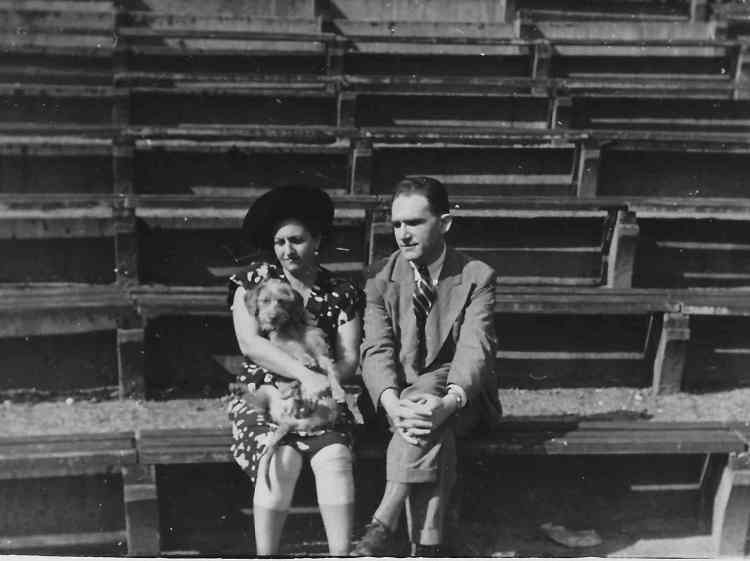
She had no business going, no permission to go where she did, but she went along with him into the camps, and there were two incidents which I remember. One was a normal conversation. Bill Ebenstein had that professorial look and had that fantastic gift of listening very well. He listened with great interest and with visible signs that the other persons had made an impact. A typical interview would bring him to the subject of concentration camps and the German interlocuteur would say, “But, we didn’t know what was going on in the concentration camps.” He’d say, how is that possible? “Well, Professor, we just didn’t know. We knew there were camps, but we had no idea what was going on there.” Then he would drop the subject and the person would, sooner or later, state that he was of course no Nazi, in fact he had no sympathy for it, and was against it. And Ebenstein would say, “Well, what did you do?” and he’d say, “What do you mean, ‘What did I do,’ Professor?” “Well, I mean, how did your opposition manifest itself? What did you do against Nazism?” “Well, Professor. You don’t understand. In a regime like this you couldn’t do anything.” He said, “Well, yes, yes. But what would have happened if you had done something?” “Well, I would have been sent to a concentration camp.” So Ebenstein would say, “Well, what was so bad about that? You knew they existed, but there was nothing, as far as you know, nothing terrible going on there. Was there?” And that usually ended that type of interview.
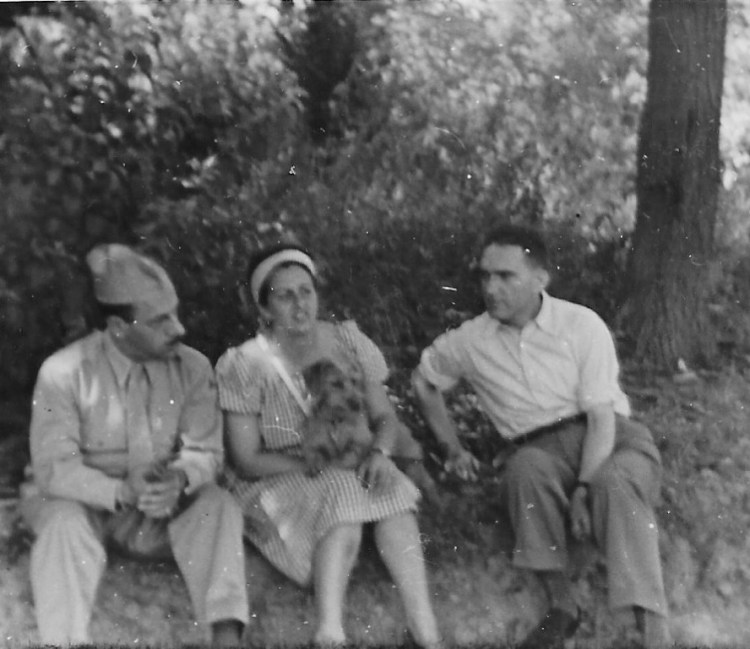
Another one, a rather memorable one was his interview with Prince Phillip of Hesse, or Phillip, Prince of Hesse (I never know which one is the right way to pronounce it. It was changed when Germany abolished aristocratic titles and I never know exactly how it works.) Phillipp von Hesse was a leading Nazi and a prominent figure in Germany and therefore quite a propaganda catch for them. He was in a camp near Darmstadt. He had an orderly, and before Ebenstein could interview him his Prince’s approval had to be given, and apparently, he had been briefed of the visit, and Mommy sat in on the conversation. And the good Prince held forth telling Ebenstein of all the anti-Nazi actions that he, the prince, had undertaken, and how much he fought against it, and all the statements he made and wrote against it. And Bill would look at him with great interest, always nod his head in understanding, and then he would say, “But, how, sir, does that jibe with what you wrote on page 34 of your book published in a given date, and name, rank, and serial number,” completely disturbing the spiel of the good Prince who had been doing this for quite a while, and this was the first time he was caught by somebody who could cite back to him his own incriminating statements. It was great fun, and Mommy enjoyed it hugely, together with my disapproval of her presence. She enjoyed that too.
Now, let me tell you about the people in the other type of camps, in the Displaced Person Camps. That was quite a contrast. The camps had been detention camps under the Germans. The difference was that the DPs now lived in the barracks where previously the guards had lived.
 Victor Gruder