Above you will find a digital copy of Cassette 11B, recorded by Victor Gruder. What follows below is our best efforts at transcribing the contents of the recording. Occasionally, an informal translation or editorial aside is inserted in square brackets ([ ]) for clarity or context. Anything underlined is a hyperlink. As with the title of each “Letter”, they are our addition, and we deserve all blame for incorrect statements or assumptions.
……………….
It was a somewhat complicated arrangement. The French insisted that all contracting for the U.S. Army would have to be done through them. That is, we would let them know what we want, they would do the contracting on our behalf, and at our expense, but in the name of the French government, and in accordance with French governmental contracting rules. Now the U.S. is totally unbending in things like this and insisted that any money spent by the army must include contractual provisions on which the Congress insisted. It wasn’t really Congress; it was the army. It was the military agency in Washington which had devised certain contract rules and they insisted that they had to be adhered to as if they were something like coming down from Moses directly.
And I set out to negotiate with my French counterpart in the mission, in the French liaison mission, a basic agreement of our mandatory clauses which we asked them to include into their French contracts. And there I discovered, somewhat to my surprise, that when a government contracts for something you arrive at a certain set of conditions and rules which are amazingly alike when you compare it with those that you do in the other country. I’m, now, well familiar with these rules – well, let’s say for France, for Germany, for the United States – and the differences are minimal. As a matter of fact, I believe we finally ended up with only two or three minor changes and none of them involved going back to Parliament in France or going back to the lawmaker in the United States. They were more or less cosmetic. But it took a long time to overcome the stubbornness and pride, national pride on both sides. It was very valuable experience because I believe this is where I acquired the basis that came in very handy later on in NATO.
I worked in Orléans for three years, by which time I had made friends with the people in EUCOM (EUCOM was, sort of, the Defense Department representative of the military in Europe,) but they were the American arm of SHAPE. SHAPE was located in Rocquencourt, and EUCOM, a little bit further in the Camp des Loges, and there were many conferences in which the three services participated. And I became very friendly with the people in the Air Force who had their headquarters in Wiesbaden, and particularly with a young colonel, Snavely, Bill Snavely, and we became very good friends. He was an extraordinary man. I’ll tell you later about him.
Of course, I was getting a bit tired of this commuting business and once in a while, or at least once a week, I managed to have a conference in Camp des Loges or in Paris. But four times a week I had to make the trip, so I was looking for a job in Paris — that is, a transfer to Paris. And after three years I was in fact hired away from the Army by the Air Force, which offered me a GS-14. That, the Army pretended they couldn’t match. When General Gallagher, the Chief, learned about it he gave orders to the Personnel Division, but the head of Personnel was a GS-14 and he was not about to give anybody else the same rank, so he “couldn’t” — and just as well, because that meant I moved to Paris (rather, I moved to an office in Paris,) and I became the liaison man between the Air Force headquarters in Wiesbaden, where the Procurement Division was headed by that Colonel Snavely. And they had a procurement office, a fairly small procurement office, in Paris and I had the dual function of being liaison with the French government on all questions involving the Air Force and was assigned to the Paris liaison office which was run by the Air Force. I had a colonel there as a boss, but I really reported functionally to the people in Wiesbaden where, I frequently travelled to Wiesbaden.
My job began on the 1st of January — now, three years, that must make it, what, ’55, I think? And, that isn’t right. No. It must have been ’56. Because my very first assignment with the Air Force was to accompany Colonel Snavely and a whole bunch of officers to Casablanca, to Morocco. We landed in Casablanca. It was an old propeller plane, C-47, which I had flown a lot in my parachuter days. They fly very low and are, of course, not pressurized. But all these officers were flyers and they had to get in flying time, for they got extra money for that, so they flew, and I was a passenger. I had a cold, and that cold got into my ears, and I arrived in Casablanca a very sick person. I had a terrible earache and had to see a doctor there. I met one of our military doctors who grounded me, so I never got beyond Rabat. I was in Rabat, Casablanca. They went on with their plane and I stayed until the ears cleared up, and then flew back Air France, which was considerably more comfortable than the C-47, but that was my only visit to a North African country. I was there, I believe, for a week.
Mommy just straightened me out on some of the dates. I worked in Orléans from ’53 for three years, and we lived on Boulevard Saint-Michel until ’55. In August ’55 we moved to the Rue de l’Université, and I still went to Orléans, and in January ’56 I started with the Air Force and no longer commuted.
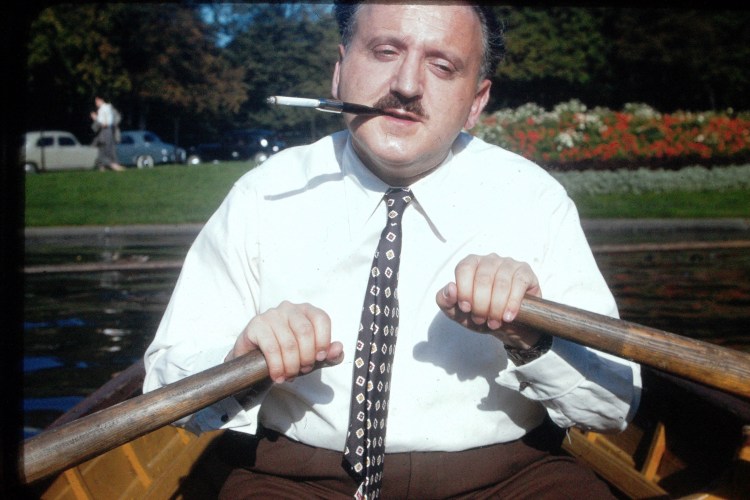
You, after you came back with Mommy from Nice, you started to go to school, and you went to Père Castor. You were five at the time and you enjoyed that very much. It was a wonderful school. We liked the directrice very much and you also had some teachers we liked very much. We liked the whole concept, and this is where Catherine Fried became your friend, one of your friends.

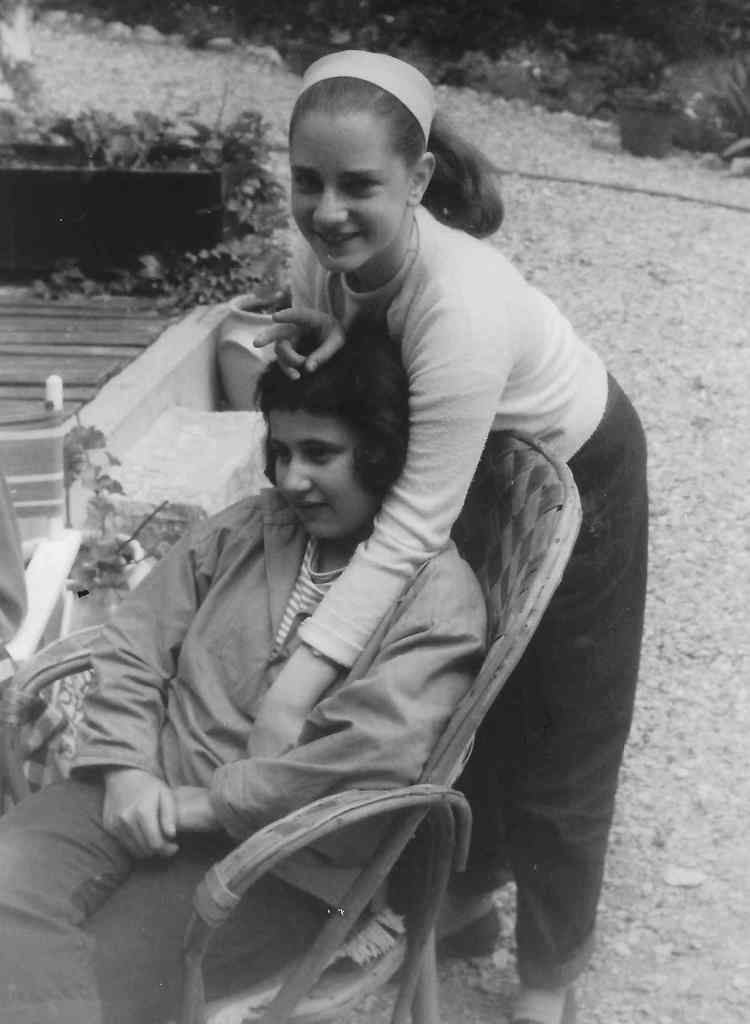
And we befriended the the parents because we went once to a parents’ meeting, and there was a gentleman speaking up, and he said the sort of thing which we so fully agreed with, that, during the coffee break, we sort of introduced ourselves to them and learned that we had a somewhat similar background, and this is where our friendship with the Frieds started.
You were, by then, completely trilingual. That is, you spoke easily and fluently in German with Lenchen, and English with us, and French in school. There was no problem, except that, obviously, as you grew, your vocabulary in French and, automatically, in English, improved and matured, while the vocabulary in German, which you spoke with Lenchen, did not keep quite pace with that. Which isn’t surprising. However, your pronunciation was excellent. I don’t know what one could have done about it, because I think, still, that it was the right thing to expose you to one language at home and another one in school. I don’t believe that one could have pursued this really, trilingually. Perhaps one could. I don’t know. Anyway, your German is good enough as it is.
We had a large circle of friends, and we really had a fine time in Paris at that époque, and one of the by-products of living in that house on the Rue de l’Université was the fact that in the same house was, and still is, the Galérie Berggruen. Mr. Berggruen is a Berliner who grew into one of the foremost galleries in Paris and, since we were neighbors, we would of course talk to each other and discovered very quickly a similarity in background. We sort of became friendly and were always invited to his vernissages [exhibition openings].
That leads me to an entirely new chapter: our education to learn to appreciate, in which we learned to appreciate, contemporary art. The exposure to it came through Berggruen when, at one of the early shows — and as a matter of fact I remember it was a Gonzalez show, totally abstract sculpture — and I asked him, “Look, like every Central European, I’ve gone to museums, but my understanding, my liking, my relationship ends really with the Impressionists. Nothing after Van Gogh.” And here in Paris we were surrounded by — not surrounded by, but on every corner, you saw affiches [posters] for, on every coiffeur shop and elsewhere you saw affiches for shows, for galleries, with abstract artists, showing abstract artists. You couldn’t help seeing them. So, I asked Berggruen, “How do you go about learning about this? What do you do to educate yourself?” and he gave us a very wise answer which went something like this: “Go to exhibits. Keep on looking, and at the same time, try not to make any judgement. Don’t think that you have to come to terms with it, whether it is good or bad. You admit you don’t know this. And, secondly, do not even try to determine ‘this I like’ and ‘this I don’t like.’ Just keep on looking. The rest will come by itself.” And, miraculously, he was correct.
Let me go back a bit and explain what our exposure to art was in Vienna. I think I have mentioned once before that, before the advent of radio, and surely of television, that one had to go out of one’s way to acquire the pleasures that you wanted to indulge in. You had to make an effort. You went to the theater, concerts. You also went to the Urania, which was something, was sort of a popular institution of higher learning on a popular basis, and you would get nature films there, and lectures. Very interesting ones. And en plus one went to the museum. Whether it was in Vienna, or when one went on a trip, any self-respecting, half-way educated Central European made it his business to go to the museum. So, at a very tender age, my father took me to the gallery, to the National Gallery in Vienna, the Kunsthistorische Museum, and I learned to look at pictures. My father was no great expert in painting but knew of course, again, as every educated person in Europe was expected to, he knew the names of the more famous painters and, besides, there were signs underneath which showed the time in which they lived. But I didn’t get much of an education from him, I got exposure. Just as I got exposure in the field of music, as I told you, from musicians, from a singer as far as opera was concerned, and then, later, from my own school mates in instrumental music.
But the same was true for Mommy. Mommy who, as you know, her household was a modest one, and she had to start working at a very early age, and nobody sent her to the theater, but she went. She went with friends. It was just the thing to do. You went to the theater, you went to concerts, you went to the movies, and she did that just as much as I did except that she didn’t have that crazy spell of opera going as I did. She went to the opera, of course, but not quite as I did, as an addiction, on a daily basis.
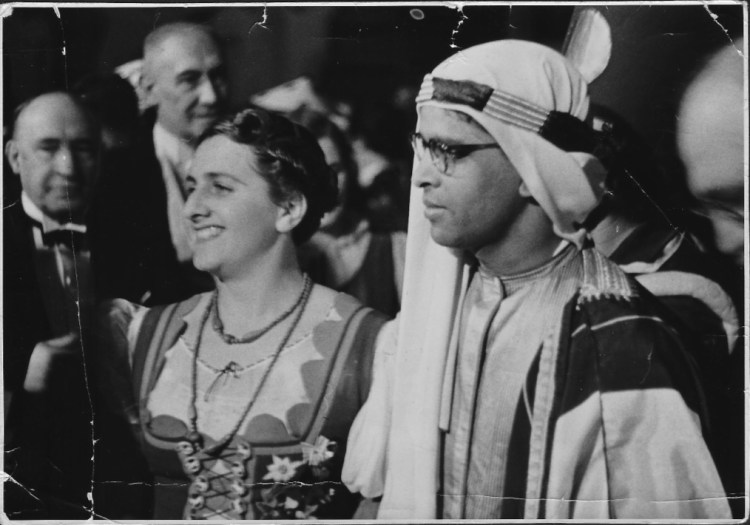
As far as the other arts were concerned, well, sculpture wasn’t terribly in evidence, but architecture was. But you lived in the middle of it, and unless you had somebody to really teach you, point things out to you, show you departures, you didn’t necessarily notice anything. At the time of the, at the height of the Jugendstil, I was nine years old (that’s the time, incidentally, when our family portraits were done) [ed: see portraits of Ignaz, Cicilia, and Victor in Letter 6 “Viennese Refugees,”] and Art Nouveau, Jugendstil, Secessions, this existed around us. The only exposure to it that I do remember was that there was some inner decorators, interior decorators, who took a new departure and did some very interesting fabric design, the whole school of this being called Wienerwerkstät, and it was very pretty. Not “pretty.” Very interesting. Very exciting to us. That was when I was in my student days. I was very attracted and that was when our generation, the young, wanted to throw out their beds and get couches instead, couches on which you could sit during the day and then you would, it would transform into beds at night. That was the big style then.
Then I became conscious of the fact that I didn’t really like the state furniture that we had at home which not a, not period furniture. It was very good, bourgeois, fin-de-siècle type furniture, and mixed with Art Nouveau, 1920 or so, which I learned to detest because I felt attracted by the Bauhaus idea of straight lines and purity. And I swore that as soon as I would have my own place, I would have nothing but modern furniture. I think it was only a bit later that the Scandinavian furniture came into its own. (Yes, I believe that’s a post-World War II phenomenon but somewhat kindred because that, too, attracted by its purity of line.) Later on, when I lived in Paris — it was during the World’s Fair — I had become quite expert in the – well, I shouldn’t call it “expert.” I had frequently been, so frequently been to the Louvre that I could guide people through it, and I also got very interested in painting. I read a lot about it and was able to tell people someting about the paintings they saw. I got a little bit interested in sculpture; it didn’t go beyond Rodin. And of course, my great love for the Impressionists, which at that time were not in the Jeu de Paume but in the Louvre, in a particular part of the Louvre, and the other museums in Paris. There was great interest in art, but very little interest in contemporary art, except in one area.
Oh yes, I better say, it certainly wasn’t in the area of music, because my taste for contemporary music ended somewhat with Richard Strauss which, after all, was — I was still a contemporary of his. But nothing more daring than that. And people like Schenek [ed: perhaps Schenker], Schönberg, Berg, all the modern, the now so famous modern Viennese school, didn’t attract me at all. I didn’t understand it, I didn’t like it, and music was something I thought I knew something about. And that, as a matter of fact, has not changed. Although I had the great pleasure of listening to lectures by Anton Webern, I never got to appreciate any of his music, and as far as Bartok is concerned, I could pick out fifty percent of it and live very well without the other fifty percent.
The only field in which I sort of kept contemporary was in what I would call political cabaret. There I was up to date and quite very well read in the history of it. That interested me very much, and I kept up with it. Although it’s an art form entirely different from painting, and it’s also different from literature – it’s not exactly the same thing – but I was terribly attracted by political chansons and the like, and still am to this day.
Now, back to the contemporary art scene. In Germany there were, and after 1918, after the end of World War I, there were a number of great artists who became, or were, socially conscious. Their pictures became political statements. That included such people as George Grosz and Käthe Kollwitz. There were some writers in the same vein, and they attracted me very much. Of course, the fact that they were contemporary means only that we lived at the same time but that wasn’t abstract art. On the contrary, it was very cogent to the time and, as I said, made a political statement and fitted very well with the period of Brecht and Weill in another field. And it had quite a literature in the same politically and socially conscious vein. The post-World War II period was amazingly fertile in art, for the growth of art, which I mention because it was hardly the case after the end of World War II. In order to correct that: it was not the case in Germany after World War II. In fact, Germany has produced, since the end of World War II (and we, this is now more than thirty years) only a handful of first-class writers of international niveau and, in the field of painting, again, only a handful who made a splash. Compared to the heydays of Berlin in the late 20’s, the sum total is meager.
When, during the war, immediately after, when we were in Germany, in military government days, I had an opportunity in Berlin to acquire cheaply art. You know what I did acquire. I collected quite a number of Kollwitzes, Zilles, Pechsteins, and you know the story of that. I won’t go into it. But George Grosz, this is where my taste ran. But I did not have the idea as, for instance, Allan Dreyfuss had, to buy for what for me at that time would have been a considerable amount of money, an oil by George Grosz. Allan did, and he later sold it for very much money. Had he held onto it, it would be worth a fortune today. Incidentally, it’s hanging in the museum in Düsseldorf.
So, Mommy and I started to become interested even in furniture, only after we came to Paris. We at first had to rent and in Germany we were assigned furnished houses. When we came to France we could only get, to rent — only get furnished apartments because the people preferred to rent them furnished. That meant that you could always get the locataires out, while if it was unfurnished the law gave them sort of squatter’s rights. Anyway, that’s what the people were afraid of, and that’s why they only would rent it furnished. And they could ask for more money that way. But eventually, we wanted to have our own furniture and we started to look around. We started to go to the Marché aux Puces, and the Swiss market, and started to learn about it, and developed a taste which had started, if you will, in Germany, where we were very much attracted by Biedermeier, and the closest thing to Biedermeier in France is Régence, Louis Philippe, Charles X. So, that’s the type of furniture that attracted us and that we eventually learned something about, we read about it, and acquired.
In the field of painting and sculpture, as I said, we set out deliberately to learn something about it, and we did what Berggruen told us. We went to shows, we went to exhibits, and the Grand Palais, Petit Palais, galleries, and what have you, and kept on looking somewhat as somebody would go to a play in a language he doesn’t understand. And then I distinctly remember that at one point Mommy and I saw, in an exhibit, a picture, totally non-objective. I said we have seen something by that same painter, and I referred back to some exhibit we had been to two weeks before. And I looked at the name, and indeed it was by the same painter. So, it gave us pause. If you can recognize the style – no, or rather, if you can recognize something to be by the same painter, then it implies that that painter has a style of his own, a recognizable style of his own. Anyway, obviously he did because we recognized it. And this discovery, this sensation of recognition, is the first step to understanding. It’s the first step to becoming addicted because, of course, now we were starting to look for similar experiences. And then, I can’t tell you how it comes about. One day, and I think it’s a pretty sudden experience, the penny drops. You suddenly have a relation to an abstract painting.
Sharing our new experiences with our friends, talking about it, we ran into the stereotype answers: this is the sort of thing that my eight-year-old child could do. Or: what does it mean? Or: what does it represent, rather? Now to ask what a non-representative, a non-objective, painting represents is of course a contradiction in the question, which is inherent in the question already. And the need to explain this deepened our own understanding. And then you pick up catalogues and some works about what you see, some pieces of wisdom which you acquire, and then become part of your baggage intellectuel, and that included, for instance, an answer once read. And people objected to the fact that a picture didn’t represent an object, and therefore was not something that the painter had seen or that the viewer of the painting could have seen, I was able to answer that nobody had ever seen figures with wings, and yet one accepts with no difficulty angels being painted on ecclesiastical paintings with wings and nobody finds that particularly illogical. When people objected to the fact that certain Picasso heads had totally misplaced eyes, I soon learned to tell them that he simply made two portraits on one canvas. And it was my own discovery that you can prove that to the people by inviting them to cover one eye and blot out the one half of the face and look at it only, the face you see, look only at one face with its eye, and it’s perfectly proportionate. And then do the same thing by covering the other eye, and looking at the other half of the face, and you have the same sensation. And all that happened is that he looked at the face and saw it from many angles and painted it from at least two of those angles simultaneously. Why not?
But the most important part of the lessons we learned was not to judge whether it’s good or bad painting. Who knows? I cannot tell you whether a particular painting of a contemporary artist will survive for four hundred years, as pictures of the Renaissance did. The craftsmanship of the artist can be judged. The idea of judging that my eight-year-old child could do the same thing should be answered with the invitation to the person who said that to try it himself, and he will find out that he, as an adult, cannot do it as easily as he thought. Besides, that isn’t important. Yes, indeed, the sort of thing that Mondrian did, the constructivist inventions of — Mondrian could be indeed imitated. But the point is, if you did it also, you merely imitate what he did. The point is, he invented it. He was the first. It was his doing, his god-like creation, and he created something that didn’t exist before. That one can copy his more readily than a Rembrandt is merely a technical question.
What had started out as an interest in getting educated, of learning something, soon became an addiction and both Mommy and I discovered that when we are in a new town where we haven’t been before, which has a museum, and if the time should permit only the viewing of one part of the museum – let’s say it has a classical part and a modern one – if we have to make a choice, we’ll now go to the modern one. That has something to do with the fact that in contemporary art, because you cannot judge, nobody has made the judgement yet whether this is an eternal work of art that will survive for centuries. Nobody has the right to make the judgment that this is great or it’s not. One can arrogate that right if you say so, but time has not yet judged that. It gives you an opportunity to make your own discoveries. You can discover an artist and fall in love with him, his work and it’s — you have, yourself, committed an original act. You picked him, as it were. You discovered him, as it were. That, you cannot do by admiring even the most beautiful Breugel because that admiration has been going on for so long that you merely inherited the appreciation of that. And you are indeed grateful that you have been taught, that you have learned to appreciate, that you appreciate it also, just as all the ones before you did. While, with the contemporary artists, it can be an entirely novel relationship with a work of art. That, I believe, is the fascinating part of dealing, of being interested in contemporary works.
As you know, we have never invested in art. We have never bought anything with the idea that its value will increase, and one could resell it. Whatever little we have and bought, we bought because we loved, we saw, we liked it. And rather than try to catalogue these things for you, since each single piece has some kind of a story of how we acquired it, I decided to do this rather on paper, which offers an easier point of reference.
In the field of music, the long-playing records had been invented. High Fidelity had come on the market. And it became a great pleasure to listen to music, to recorded music. I remember a conversation I had with a woman in the States. It must have been after we returned to Washington in ’61. We were at a party and that woman was swooning. She was my table neighbor, and she was swooning over the fact that there were the ambling violinists of the Air Force [ed: U.S. Air Force Strolling Strings,] or some such thing. It consisted of a band which started out at various far points in a large dining room, and they converged in the middle while playing. She found that a fascinating experience, and said it was so good, “Almost as good as a High Fidelity record.” And I was outraged by this statement because it seemed to me that to compare any live performance to the substitute of an even very good record seemed to me outrageous. I, very shortly afterwards, changed my mind about it, and have since been to many a live performance, particularly here in Paris, which didn’t begin to compare with the, with my own tape of the same piece of music that I had at home. And I don’t mean to compare the experience that you have in a concert hall. Of course, nothing replaces the rapport that you feel with the other people in the hall with whom you share the experience of listening to that music, which is a very difficult-to-define bond, and that immediacy cannot be recreated. But if the performance is particularly bad, and you have a particularly good recording of it at home, it sometimes is simply superior as far as the music is concerned. And if it’s the music you want to hear, rather than the experience of kinship with the concert audience, then it’s worthwhile staying home listening to it on a good stereo hi-fi.
As to our daily life, we continued to have a very active social life. My job was satisfactory and pleasant, and we saw lots of people, acquired new friends, saw lots of other friends – we had kept from each phase of our various places of assignment, a small number of friends – so that eventually there was one group always added at the new assignment. So that we ended up having people whom we knew from Wiesbaden, others from Düsseldorf and, finally, from various periods in Paris, in Orléans. There were our old friends in the States who never left the States, whom we saw on home leaves and sometimes they came to visit. And new acquaintances and friendships were formed.
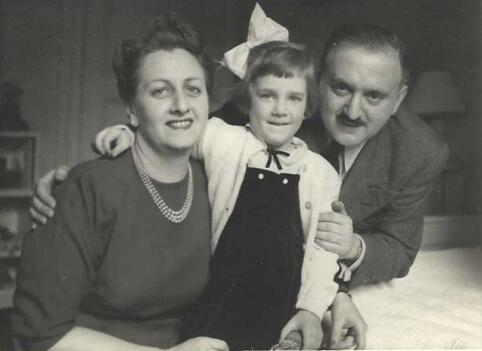
And you grew up and we took great pleasure in watching you growing up. It must have been just when you were about to get into lycée, we moved from Rue de l’Université – you know, the owners of the apartment came back from some assignment in the colonies and, very much to our regret, we had to give it up – and rented from Mrs. Beckelman the apartment in Rue Chalgrin, and that coincided with your inscription into lycée. The first lycée you were assigned to was on Boulevard des Invalides. The garden is adjacent to the garden of the Rodin Museum, but I forgot the name of the lycée. Anyway, you hated every moment of it. It was terrible. You couldn’t stand it, and we moved to Chalgrin [ed: Rue Chalgrin] and, partly because of your unhappiness with it, and because of information we had, we got you transferred to Neuilly, to a – at that time – pilot school, La Folie St. James, where you stayed until we left for the United States. That’s a period, I believe, you still remember yourself and therefore you can include that into your own memoirs when you get to it.
 Victor Gruder