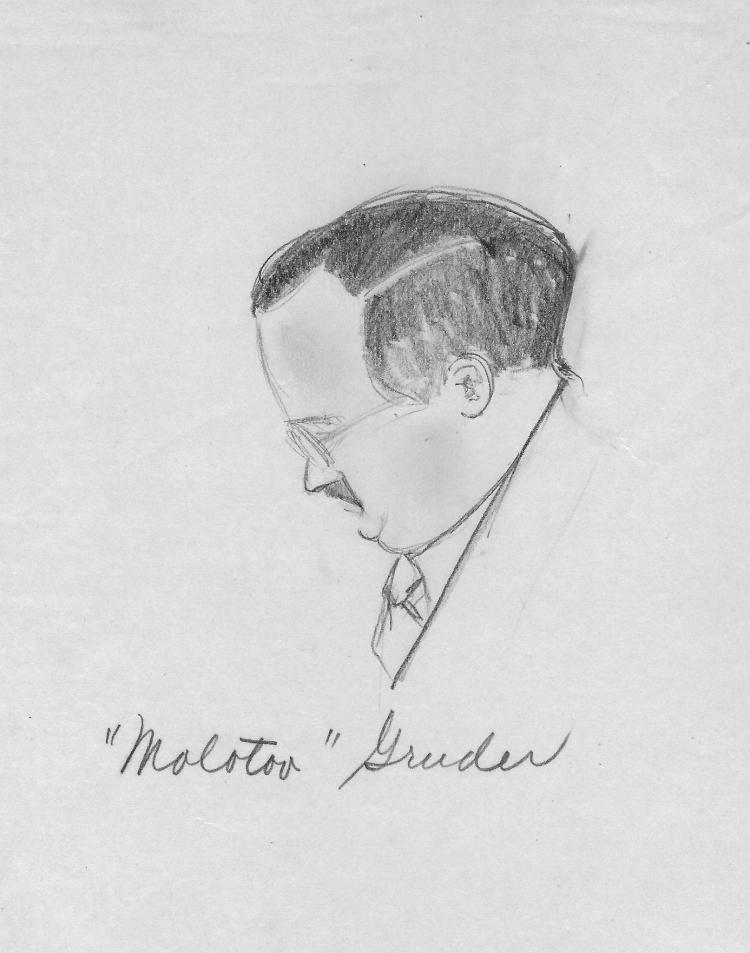
Above you will find a digital copy of Cassette 10B, recorded by Victor Gruder. What follows below is our best efforts at transcribing the contents of the recording. Occasionally, an informal translation or editorial aside is inserted in square brackets ([ ]) for clarity or context. Anything underlined is a hyperlink. As with the title of each “Letter”, they are our addition, and we deserve all blame for incorrect statements or assumptions.
……………
And it always came as a shock to hear that kind of language come from this dignified, six-foot-four tall gentleman.
Parkman was replaced by Ambassador Livengood who was a kindly, elderly gentleman as far as his last State Department assignment. He didn’t make waves. He liked to drink a few drinks, and his wife a few drinks too many, but those were their only faults. Otherwise, he was like a father to us and a very skilled, skillful diplomat who carried out instructions and — incidentally, instructions. The whole experience in the Ruhr Authority taught me a lot. For one thing I, being in daily contact with a bunch of ambassadors, top-level, I lost any kind of self-consciousness about rank. I found that you could talk to these people just exactly as I talk to you and if you did, they talked back to you in exactly the same way.
Another thing we learned was how you make policy. You need a policy decision, and you have to go back to Washington with a cable asking for instructions, and the instructions either wouldn’t come or they would come late. So, we learned very quickly a simple trick, to cable as follows: “In the next meeting on — that was five days off, or three days off — the following agenda points will be discussed. Unless you instruct otherwise the position we shall take, is as follows…” and we proceeded to give what our intentions were. And since that made it awfully easy for the guy on the other end, who by no means had anywhere the rank or the wisdom or the knowledge of somebody like Parkman, the easiest thing for him was to do nothing. And this is how policy is being made in the field. I later discovered this is true for all field agencies. It was true in NATO, and what I had learned then in Düsseldorf came in very handy later in NATO.
We were not always very busy. There was lots of time for talking. We had conversations about things that had nothing to do with business. I remember one piece of advice that Livengood gave me, which I have never forgotten. I was, at that time, thinking of buying a piano, our piano, our Schimmel, and it was a considerable expense, and I did know that we may have to go back to the States. And what is better? Do I buy a piano here? Do I buy it in the States? Is it worth the expenditure plus the transportation costs? And I discussed that with my colleagues, and I also mentioned it to Livengood who had recently (well, only a few months earlier) come from the States. I asked him, basically, whether I should buy that piano. And he answered this with a question. He said, “Vic, before I tell you anything, you have to tell me one thing. Do you want me to talk you into it or out of it?” That proved an enormous piece of wisdom. I have applied it very frequently since. It summarized in one single sentence, what it is that you are looking for when you are allegedly seeking advice. When you go to a friend for “advice,” what you are really looking for is confirmation.
Well, things in Germany changed. Our organization was clearly going out of business. So was the High Commission. And I started very actively looking for a job, and I had my heart set on an assignment to Paris and to the Marshall Plan. That was the most exciting thing at the time, and I always wanted to be assigned to Paris. So, I started to look around – no, you don’t look around. You tell your friends, you let it be known to everybody that this is what you want. This is where you would like to go. And Joe Slater had transferred to Paris, to the Marshall Plan. As a matter of fact, the head of the European Marshall Plan was some super-ambassador. Originally it was Harriman. (Yes, the same Harriman whom you still know. No, you don’t know him, but you know of him.) He built an empire and by the time when I was getting interested, it was Ambassador Draper. He had just been appointed as the U.S. representative for Europe — and very much to the dismay of the regular State Department guys, because he was made senior to all the other ambassadors, the regular ambassadors to the various European countries and agencies, and that didn’t sit very well with them.
Mike Harris also knew that I wanted to go to the Marshall Plan Office, and he contrived an interview with one of his pals there. After all, he was the Marshall Plan Minister in Germany, and I got an interview which didn’t lead to anything right away but eventually it did and I did get an assignment which took me to Paris in 1952. I was assigned to the Industrial Resources Division, then headed by Nathaniel Samuels. And you may know his name because he was Assistant Secretary in State, Assistant Secretary for Economics, not so long ago. Mommy had gone ahead to look for an apartment in Paris, which at that time was extremely difficult to get, and she found one on Rue Leningrad which was our first residence in Paris. I’ll tell you more about our personal lives in Paris later.
Let me first tell you about the job. While it carried a very good rating (it was an FSS-2, which is only topped by 1,) it was a frustrating job from the professional point of view. The Industrial Resources Division was full with specialists in certain areas of economics or industry, and the man who had hired me had apparently done so as a favor to Mike Harris, and Samuels didn’t exactly know what to do with me. He finally had the good idea of making me the liaison man with the now-existing agency in Luxemburg, the Schuman Plan Agency Coal and Steel Commission. I was Ambassador Draper’s liaison man with that office. Well, that in itself would have been very interesting, but it led to a very ambiguous situation. There was a big war on between the State Department and the Marshall Plan Agency, the latter having grown into an empire, enormous under Draper. It was the aim of the State Department to bring things back under their own control. And our man in Luxemburg (as a matter of fact, a man who was very much responsible for the American support for Monnet and his ideas, and the Schuman Plan, and the Coal and Steel Commission — the Coal and Steel Community,) was a man by the name of Tomlinson. A brilliant, young — fairly young — State Department officer who had one thing in mind, and he did bring it off in the end, and that was to get a U.S. Ambassador assigned to the Coal and Steel Community. And the assignment eventually was made, and it was Ambassador Bruce who, in my opinion, was the most gifted American diplomat in my time.
My liaison functions were supposed to bring news from Luxemburg of what’s going on to Draper. And Draper had, of course, many, many agencies and assignments under his control. I once saw the briefing book that Joe Slater kept up to date for Draper, which he received every morning. There were 24 different agencies – you know, a folder with 24 spaces for reports of what they were doing — and the Schuman Plan business was just one of them. I was supposed to bring back what they were doing. It wasn’t exactly spying on them; after all, these were U.S. offices. But Tomlinson made it abundantly clear that when I was in Luxemburg, I was working for him and not Mr. Draper, and that I had no business saying a word about what I learned in Luxemburg to my office in Paris, which, after all, is the one that paid me and sent me there. It was a very uncomfortable situation. I had to write anodyne reports, and there was not that much to report, and it was a frustrating business.
It was interesting only in another respect and that was, it brought me into contact with very interesting people. First of all, I had the great pleasure of seeing Jean Monnet in action and he surely is, has, was one of the greatest brains and personalities in my lifetime. An incredible man, a hard task master, a superb speaker. When he talked about European unity, he made sense. Whatever he said, he made sense immediately and to everybody. I only know one other speaker with that gift. That was Paul-Henri Spaak, also a great pan-European.
One of my colleagues, who at that time was much of a playboy, was a man by the name of Cleveland,

who was the brother of Ambassador Cleveland who much later became my boss in NATO. (No, he wasn’t my boss but who was ambassador to NATO, while I worked on NADGE.)
One little bonus working in Luxemburg was that it afforded me the unexpected pleasure of meeting and having much to do with Mrs. Perle Mesta. Truman, then our president, had assigned her as the ambassador – it was only Minister; we didn’t have an embassy, we had a legation — to Luxemburg. Mrs. Mesta was a very rich woman — in steel I believe. She had been rich before she married, then she married more steel money and was a rich widow known in Washington as Washington’s number one hostess. There was much amusement and mirth when she was appointed ambassadress to Luxemburg. As a matter of fact, there was a musical written about her, called “Call Me Madam,” played by Ethel Merman, which was a Broadway hit for several years and clearly patterned after Mrs. Mesta.
So I was, of course, very curious meeting her. And I discovered a number of surprising things. She was a short, not at all good-looking, woman in her late fifties or perhaps sixty. She kept, she had brought with her four of her own black servants from the States, which took care of the official residence, in addition to the help that she was entitled to as ambassadress, and the surprise came when I realized what this woman had done for American prestige and popularity in the little country of Luxemburg. She really put that country on the map for American tourists. She had the idea of holding Open House, I believe once a month, for all GIs in Europe. If they came to Luxemburg, they were automatically invited to her house where they got hot dogs and potato salad. She let everybody know that the recipe of the potato salad came from Eisenhower. She had a picture to prove it: Eisenhower with a big chef’s hat in her kitchen in the States, making potato salad. Her residence was filled with pictures. She had been, of course, a great contributor to the Democratic Party for years, and there were dedicated pictures of every great name in American contemporary history you can think of.
What surprised me was her incredible popularity in Luxemburg. I had occasion to ride with her in her official car. It was a standard, and a car with the American flag, and every single man on the street would lift his hat and greet the car or rather her, in the car, whenever she rode through the streets of Luxemburg. The people genuinely liked her. And although she had made her reputation as a hostess, she was by no means a dummy. She was a good politician. As a matter of fact, she treated Tomlinson and me to a long discourse that if in the next election Eisenhower gets elected, she expects to be reconfirmed as Ambassador to Luxemburg because Eisenhower was a personal friends of hers too. That, of course, was nonsense, but she sincerely believed that.
The other interesting experience was being a guest at several occasions at parties that she gave, and those were parties given by a lady whose reputation was to be the first hostess of Washington. Now I learned a lot how that is done. She had her daughter, her daughter’s husband, some other relative, they all acted as co-hosts, and if there were fifty people in the party, there was always — well, frequently, one — she or one of the other co-hosts — was engaging every single guest in a bit of conversation and every guest was made to feel that he was a guest of honor. She did that extremely well. The conversation would go something like, “And how is Mrs. Gruder? And how is your daughter?” Of course, if you answered, “Well, Mrs. Gruder just broke her leg and is in the hospital,” she would have said “Well, that’s nice,” and gone onto her next question. That means, she didn’t really listen to what you answered, but she said all the right things to her guests.
The food was excellent, and she had another principle. She once explained to me that she has two standard dinners which she uses ultimately for her guests because most of her guests come either once or, at best, twice a year, at which time it is perfectly alright if they eat the same thing as long as what they are getting is first class and that, indeed, it was. Another lesson I learned from her.
One memorable occasion in Luxemburg was a party at the occasion of Thanksgiving. There was a thing called the Luxemburg-American Friendship Society. That society had invited Ambassador Draper to come to the great dinner they gave and be the guest speaker. And Tomlinson and I had to explain to Mrs. Mesta that Mr. Draper would come, would spend the night, but not stay the weekend because he had to go on to NATO for the Annual Review, and Mrs. Mesta said, “What’s the Annual Review?” Tomlinson and I had a hell of a time explaining to her what the Annual Review was. On the other hand, she wanted to know whether, in the thirty-two-people party that Draper was bringing with him in his private plane, his daughter was coming along, and neither Tomlinson nor I knew even that he had a daughter. So, as we left, Tomlinson said to me, “You know, it’s amazing what the government pays me for. Here I am supposed to talk to an ambassador. She doesn’t know what the Annual Review is, and I am supposed to know whether Draper is bringing his daughter.”
The purpose of our diplomatic missions to Mrs. Mesta that day was to explain that Draper cannot be her guest for the rest of the weekend. She was very distraught about this but accepted it. And there was a concert, given also by that society, sponsored by the society. But she had also bought tickets for Draper and his party. Well, I guess Draper probably didn’t have to pay, but anyway she informed me that she had bought thirty tickets; that when she heard that there were thirty-two people accompanying Draper, she got very impatient and said, “Well, I only bought thirty tickets, and the other two will have to shift for themselves. I am no longer as rich as I used to be.”
When I was one of her guests at the concert, and I was instructed — she let it be known that she would like to have the people on the staff, the regulars in Luxemburg, be on hand very early because seats were reserved for the American honored guests and once they were filled, any space left would be filled by the overflow of other Luxemburgers — and so she wanted to have her party there early. Well, I arrived indeed early and there were only two other people in the concert hall, a very large concert hall. One was the archbishop of Luxemburg. I’ll explain more in detail who he was. And the First Secretary of the embassy. Now the First Secretary was a person that I could never keep my face straight when I saw him because I had to think of the figure in the musical, of the guy who plays the first secretary in the musical. This man, the real man, amused me because I had never seen him sober. I saw him at all hours of the day, the night, the morning, and I have never known the man to be sober. Perhaps the fact that after some thirty years in the State Department, or close to that, this was his first assignment to a white country, may have accounted for his addiction to liquor. Anyway, he introduced me to the bishop and left me alone with him.
Well, the bishop was actually a monsignore, who was “acting archbishop” because the archbishop of Luxemburg was incapacitated for health reasons (a very old man,) and thus the monsignore, as acting bishop of that bishopric, wore the bishop’s ring. He was a tall, bony man, somehow looking a bit like our present-day pope, very athletic-looking, and he sat in the first row. I sat next to him, and we conversed in French. I was in a panic because I had forgotten how you address an archbishop, particularly if he isn’t one, in French. What do you call him? La grace? Excellence? Anyway, I didn’t know. I managed to converse with him all evening long without once addressing him by his title. But the other complication was that many of the people who came in and saw him, came forward, genuflected, and kissed his ring. He, every time somebody came forward to do that, very athletically got out of his seat and got up and held his hand out and I didn’t know what to do. I sort of got up with him. Every time he got up, I got up. It must have been quite a sight.
The whole thing was crowned with the appearance of Mrs. Mesta in a couturier dress, surrounded by her acolytes, entering the concert hall, and when she saw the bishop she did something which was somewhere a cross between a court curtsy (that she had learned for her assignment to the Court of Luxemburg) and a genuflection (because an American Protestant is not going to genuflect, really,) and so, she had devised some sort of a cross between the two. And in the actual fact, she was a short, dumpy woman. It looked extremely funny, and it was almost impossible to keep, for me to keep, a straight face, because in the musical, which also made into a film, when Ethel Merman played this and makes her first curtsy, she falls on her behind. It was almost inescapable that this was going to happen to Perle but, but it didn’t. Well, that much about Perle Mesta.
One more thing about the party. The party was on the evening of Draper’s arrival and during lunch, I had to arrange a seating arrangement for his party to have lunch with Mr. Monnet, and I never had arranged an official party. We went to the library and found a book of etiquette. We didn’t have a protocol book, and I had a hell of a time figuring out how to seat the people in order not to put poor Mr. Monnet between Mrs. Mesta and Mrs. Draper. Mrs. Draper was a particularly beautiful woman, but Mrs. Mesta would probably not have been the most interesting table companion for Monnet. Ayway, we struggled through this. We, that means somebody from Draper’s staff and myself. And I was afterwards very graciously thanked by Mrs. Draper for the excellent arrangements and — for the big sigh — I told her that I would not enjoy doing this for a living, which she laughingly acknowledged and understood.
Draper himself, you know, Ambassador Draper, was a banker from New York and an extremely gifted diplomat who was not a professional; as a matter of fact, neither was Bruce, neither was McCloy. These were people who, although they came from civilian life (they were not professional State Department people) made excellent ambassadors. Well Draper, as a hobby, was a magician. He did card tricks and when he started to hold his speech during the dinner of the society, he addressed them, said, “At Thanksgiving we all want to have a good time. You didn’t come here to listen to a dull speech by yet another politician. You hear enough of that anyhow. I’m going to do card tricks for you.” And there was America’s senior ambassador in Europe doing card tricks. There was a moment of stunned silence and then the people absolutely went wild, first of all, that he did it at all, secondly, he did it extremely well. It was very entertaining, and I believe that that sort of thing — I cannot imagine a French ambassador or for that matter a British ambassador ever doing a thing like this. It was typically American and wonderful.
I commuted a lot between Luxemburg and Paris. I wrote reports. I wasn’t quite sure that anybody would read them, and I wasn’t even sure that if somebody did read them, that they were of any value. It was the only time in my career where I felt completely frustrated by my job because I couldn’t see that it really contributed anything.
Our personal life was very agreeable, wonderful. We had friends, we made new ones. I think it was at that time, — no, I know that it was at that time that I had dealings with Leon Goldenberg, Judy’s father. [ed: Judith Goldenberg, along with her brother and parents, were long-time family friends of the Gruders although Leon died very young. Tragically, Judy, a senior Defense official visiting Egypt, would be stabbed to death on July 15, 1996 by a madman in the doorway of the Cairo hotel where she was staying.] We became friends. We saw the Tangs, whom I don’t believe you remember. We met the Obsts whom I did not, at the very first, particularly like but then got to like very much. The Kaplans. The Slaters were in Paris. We saw them.
I’m not sure whether it was at that time, at that moment, that we met the Vidgermans but anyway, when we did, that was interesting. The how was interesting. Mommy went to a party of American wives, some embassy party where women wore name tags. Edith came over and introduced herself and the two women hit it off. Then Edith said something to the effect, “We ought to meet, our husbands ought to meet. I hope they’ll get along with each other.” Somehow, she conveyed the idea, or rather, there was a slight warning that Alfred wasn’t easy to please, or rather, he had to hit it off with somebody in order to make it a pleasant relationship. Anyway, we did get together, and apparently, I passed muster, and this is how our friendship began. You know, Alfred could be very clear about his feelings. If he was at a cocktail party and he felt bored, he would go to the next bookcase, take out a book, sit down and start reading in the middle of the cocktail party. He made no bones about his feelings. Now he never did this to us so we must have been all right.
My initial adverse reaction to Maxwell Obst was the fact that he was, he seemed crude, and he made rather nasty remarks about people who may or may not have deserved it. He told at that first occasion bad jokes and sort of made himself the center of attention. It was at a party at the Tangs. So, my first reaction was a bad one but that very quickly was repaired, and I realized very soon that he was a diamond in the rough. Helen of course was the sweet person that she always was at the end. She was that from the beginning.
Now in addition to all these somewhat new friends we made — oh yes, there was one more. Quite interesting again. Lucie [ed: Lucie Bratenahl. See Letter 1 “Army Service, a Time Machine, and Postwar Unemployment”] had written that now that we are in Paris, we may run into friends of hers by the name of Hellman and if we do, well, we ought to get to know each other and gave us sort of an introduction. When I reported to my office in the Talleyrand, they told me that I would have to wait a few days before they could assign me my proper office. For the time being, I should sit at this desk, which they indicated. While it was the desk of one of the temporarily assigned consultants who was on a field trip, he wasn’t here, and I could use it in the meantime — and that consultant was Richard Hellman. So, before we even met, we shared a desk.
And then there were the Luffs and the Dobsons [ed: see Letter 10 “Dusseldorf”,] because both of them had been hired by NATO away from the International Ruhr Authority, and they were now stationed in Paris. So, as you can see, we had friends in various organizations, not only one to which I was assigned but places with which I did not have any functional connection but just connections through people we knew. In a way, that also included Mr. Parkman who was, at that time, the U.S. Marshall Plan representative in Paris. A sort of the regional boss while I was in the European headquarters of the Marshall Plan organization.
Some of our colleagues from Düsseldorf of other nationalities had returned to Paris. There was [ed: Louis] de Boysson, who was a retired French admiral who, incidentally, during the war (and obviously an anti-Nazi and a Résistance man) while he was doing nothing at home, he learned to make petit point work and he did some magnificent chair coverings for all his many grandchildren. He had been in Düsseldorf.
And we saw Parisot, who was a member of the steel group in Hessen, a French member of the steel group. He had previously been the director, the head, of the Indo-China mining interests. A rather rich family. I vividly remember an evening we spent there. He was a Polytechnicien and we were invited as the only non-French couple, with four other couples, all former colleagues of the Politechnique, colleagues of his. One of the men was a professor at the Sorbonne who taught higher mathematics. Another one was the owner of several stone quarries in France, and, as a matter of fact, he entertained us greatly by telling us how he had bought that very morning a mountain. I think one other man was there who ran something like the SNCF or the EDF — that was about the level. After dinner, the conversation got around to the various yachts they owned and I recall how one said to the guy with the mountains, “Well, we cannot compete with somebody who has got a yacht with twelve members of équipage [crew]. We only have small little yachts with two or three seamen.” And there Mommy and I were sitting with not a single rowboat to our name. We felt we didn’t quite belong.
Then of course, there were all our old French friends, like the Glücks [ed: Dicky and her second husband Francois Glück] and the Guinles [ed: Jacqueline Guinle and her family, friends of Victor’s from Orléans since his army days in France] and the Vibacs [ed: friends of the Guinles, who subsequently became close friends of Victor’s and then Jeanette’s,] and so forth.
 Victor Gruder