Above you will find a digital copy of Cassette 7B, recorded by Victor Gruder. What follows below is our best efforts at transcribing the contents of the recording. Occasionally, an informal translation or editorial aside is inserted in square brackets ([ ]) for clarity or context. Anything underlined is a hyperlink. As with the title of each “Letter”, they are our addition, and we deserve all blame for incorrect statements or assumptions.
………….
Just having checked where I left off, I replayed the first part of this cassette, I realized once more how often I misspeak myself, use wrong terms such as “relation to,” instead of “relation with.” Anyway, we have agreed once before, or rather I have invited you once before, to give me credit for noticing it. Had I written it, I would have corrected it. I won’t correct it on the tape. It doesn’t pay.
Another thing has occurred to me. I am attempting to accomplish three things simultaneously in my tale of this particular period. I’d like to tell you about the job I did (the job we did,) in military government; our lives (Mommy’s, my father’s, and mine, together in that period,) events, experiences; and give you in addition, or as I said, simultaneously, a picture of the whole period. Now this is almost impossible to do simultaneously and by respecting chronologically how these things fit together. So, I ask you to bear with me. I‘m deliberately giving up chronology where it doesn’t matter. If I’m telling you a certain erlebnisse [story] out of sequence, I don’t think it matters. Where I’m trying to paint a picture, I have to be anecdotal about it. But perhaps the whole mish mash will give you some flavor of an unique and exciting period of time for all those who were involved. Let us look at what daily life was like. Daily life for a German, daily life for an American member of military government.
Wiesbaden was relatively little destroyed. The official count was destruction of about twenty percent of its buildings. Walking through the streets you could not arrive at that kind of statistics because it looked to you as if the whole city were in ruins. You had to have a comparison and if you went to Frankfurt, where the destruction was somewhere between sixty and eighty percent, you saw the difference. But it looked pretty miserable. There were no windows, no glass in the windows. A destroyed house, a house was considered destroyed when it was not habitable. You see, aerial bombing destroys houses from within. The bombs fall on the roof, burn through the house, and burn the houses inside, which means that the walls on the outside are standing but the house is hollow on the inside, while places which were destroyed by artillery shells such as was the case in Berlin, they crushed the walls from the outside and just crush it together as in a giant bulldozer. Plus, the aerial bombing, which also took place. And, incidentally, one of the eeriest sights I remember was my first flight over Berlin where, when you come in low, you, actually, look into thousands of shells of houses, as described, hollow inside with no roof, that you look from above into the empty walls still standing.
We knew that the Germans had little to eat. The military government had established a ration system which entitled Germans to eight hundred calories a day. Rather, it established a distribution system where they were assured of getting eight hundred calories a day. You might know that this happens to be a diet which one prescribes for somebody who wants to lose a maximum of weight. It is, literally, a survival diet. Now that was the official distribution system. Obviously under the circumstances there had to be a black market because people couldn’t subsist on this minimum. There was some extra allowance made for babies, for nursing mothers. People who were, persecutees who were in Displaced Persons Camps or living on the economy but had a card as persecutees of Nazism, got double rations. We once saw what that ration looked like when we, when Mommy met Ilonka. I’ll tell you about that separately. [ed: see Letter 9 “First Post-War Years in Wiesbaden”]
At any rate, “black market.” Well, what does that mean? It first presupposes a way of paying for a legally obtained necessity, such as food. And how do you pay for it when the currency, the official currency of the country, has become totally worthless? The currency was still the Reichsmark and the Reichsmark was only usable for buying or paying for the official ration of bread. The baker couldn’t do anything with the money that he got because it wasn’t worth anything, but he had to sell against the ration coupons. So, the only thing that was worth anything was the ration coupon because it amounted to getting practically food for free with handing over worthless paper in addition to it. So, one of the ways of trading on the black market was trading ration coupons. And what you traded were, what the people traded, were possessions, luxury items, which they would trade for food. A set of crystal glasses for a pound of butter.
Yes, there were, of course, people who made butter in the country, amongst the peasants, but mostly the black market fed on illegally sold items from American stocks. GIs were engaged in giving away food, selling it, exchanging it, bartering it. It — and among the Displaced Persons who got larger rations, they also engaged in it. The survival instinct is such that where there is no legal way of eating enough, an illegal way is found. One invented at the time — one means, a new currency, one way of paying for black market items — was by paying in cigarettes. Cigarettes were obtained from GIs who got them for next to nothing in the PX or had it sent in packages from the States. A carton of cigarettes was worth X thousands of Reichsmarks or in exchange for this or that luxury item. And certain services were paid in cigarettes. A haircut, two cigarettes, and the coiffeur in turn, the barber in turn, would choose these two cigarettes to buy some slices of bread. An additional form of payment was in pounds of coffee. The most humane trading item was fat: pounds of butter. These were all items rationed in the commissaries, but they found their way to the black market.
And, obviously, as usual in situations like this, people who had luxury items to trade managed to eat better than those who had nothing, and those who had nothing to trade starved. There were also a small percentage of those who, out of principle, wouldn’t trade on the black market and those were the saddest cases. In this context we had one unforgettable experience. Mommy and Father had arrived, and we had a small apartment in Wiesbaden, and we invited Zinn for dinner. Zinn was then Minister of Justice and, of course, a man who wouldn’t trade on the black market, and he had a shrunken stomach like people who haven’t eaten a decent meal for a long time.
Very interesting: I had discovered this in Paris, when I took Jaqueline, for the first time, to the mess hall.
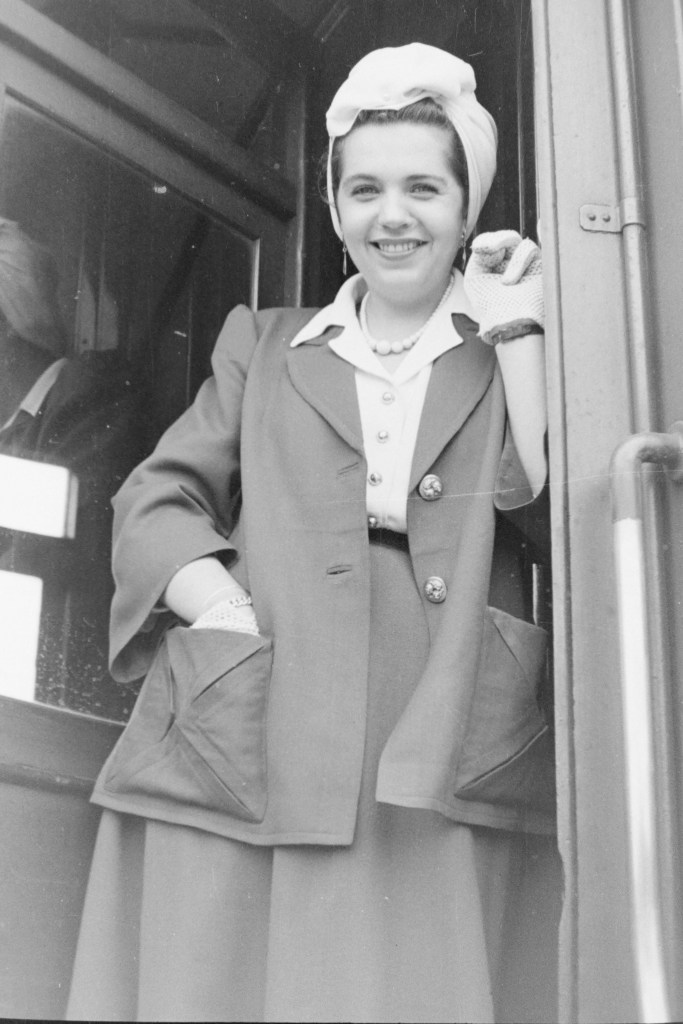
When you feed people like this a protein-rich meal, the first such meal in a long time, they get awfully hot. The caloric intake is such that they, actually, heat up like an oven. Well, this happened also with Zinn. And Lenchen, who already was working for us, came around and offered seconds. Zinn, and whoever else was there with him, declined. We understood that he couldn’t eat any more, but Lenchen, in that mixture of kindness and lack of tact, said to him, “Auf bedienen Sie sich doch, Herr Minister. Wir haben sehr.” [“Please help yourself, Mr. Minister. We have so much.”]
Compared to the Germans, indeed we did have it. The commissary was not exactly stocked as a supermarket is today, but there was no limit to the amount, the number of calories you could eat or buy. And then there was the law. The law forbad officially at the time any communication — not communication, what was the word? – “fraternization” with the Germans. You were not supposed to meet them fraternally, as it were. Obviously, it was forbidden to trade food or sell it (American food bought in the commissary,) but it was even theoretically forbidden to give it away. Well, obviously, this law was observed mostly in the breach.
As a matter of fact, there was something decent about violating the law. It was indecent to live in accordance with it because, let’s say I went to the barber. I was supposed to pay him — I don’t know — three Reichsmark, which could buy him absolutely nothing. It is not expressable in dollar terms, in purchasing terms. So, what I did do, and all my colleagues did, you paid him the three marks or whatever the advertised price was, and in addition to it, you gave him a pack of cigarettes and that was value to him. Illegal, but decency commanded that you give him something that will buy him, in terms of purchasing power, something to eat.
And so, it went. A woman came to the door once, where we lived. It wasn’t a compound. The military government was located in Wiesbaden. We had taken over the Landeshaus, which was a government building, to have the offices in and, around it, a neighborhood of villas (very much like Uccle in Brussels,) were houses which were confiscated for military government purposes, and those were our billets. It was, theoretically, the idea to billet people in the elegant and sumptuous houses of Nazis. Well, there were not all that many houses left. So, what the billeting officers did was they looked at houses that were unharmed, and the people were told to move out in relatively short time (that means within hours,) and to leave everything in it, because these billets were turned over to American occupants, furnished, fully furnished. This might now, retrospectively, seem harsh but, don’t forget, this was the end of a war in which we had seen much cruelty by the Germans. The full story of concentration camps had by then become known and there wasn’t very much sympathy for the remaining Germans.
The occupier, the victor, took over. It’s as simple as that. But that didn’t translate into personal relationships. Now, the men were without wives. The family dependents couldn’t come yet. So, they very quickly acquired German girlfriends, and there again, a mise au point is necessary. You may have read, you may have heard, that the German girls were to be had for a bar of chocolate, for a carton of cigarettes. That’s not the whole story. I met many of these girls and, some of them were very decent kids. And I believe it wasn’t so much that they wanted to eat, which is in itself already understandable. And it wasn’t for the cigarettes and chocolates that they would get for themselves and for their family. I think a good deal of it was that they got away from the dismal, miserable lodgings in which they lived – crowded, cold, not desirable — and the constant worry, surrounded by constant worry, of all the people who lived there and around them. Meeting another German was exchanging stories of misery of relatives who had died or husbands, friends, brothers who had not returned or were prisoners of war. They were particularly worried about the ones who were in Russia. And going with an American to the American club, having a decent dinner, and dancing was an escape and an escape for which they gladly paid by sleeping with a guy. I have seen cases where the girls by no means could be termed as having prostituted themselves because they were sometimes deeply in love with these carefree, sunny men, something they hadn’t seen throughout their whole childhood. They were young, so what they knew was war time, and wartime wasn’t a very gay period. And the men they had met, the Germans in uniform, Nazis, what have you, were so very different from these rather friendly, young, and nice Americans. That was perhaps the guiding element in this whole “Fräulein culture”.
I shared an apartment with a French liaison officer who didn’t live there very frequently. He stayed over in France and came only occasionally. We were good friends and since I could bring — nobody could bring family over before billets were available, he offered, we made a deal that he would move out and I could move my wife and father into this apartment until something more commodious would be available.
I was sick and tired of waiting. We had been separated for three years of war. I didn’t want to wait any longer and we decided to pay for the trip of Jeanette and Father ourselves (borrowed the money for it, or I sent it, I don’t remember,) and they came over. And they moved into this apartment in Eichendorfstrasse. It was small but we did have two bedrooms and a living room, and we were together, and that is what counted. My father was extremely pleased with everything – being, America having won the war, and coming back to Europe and, most of all, to see his son, whom he always wanted to see as a lawyer, working in the legal division. And he gloried in all the people he met — Zinn, the Minister of Justice, who was a fellow social democrat — and all that moved him deeply. They came over in October of ‘46 and we were one of the first families — that is, in — chronologically, I was one of the first who had his dependents there. A few months later many others came.
I took Mommy to the officers’ club where she met with all the men and the German girlfriends. She behaved perfectly natural, showed no particular animosity to the German girls. And you can imagine that she became extremely popular, not only with the girls but also with the men who appreciated that very much, because as soon as a wife arrived, and her respective husband shed his girlfriend, there was of course — the wife suspected something and — there was a clear cleavage between the American wives and the German Fräuleins, whom they regarded as a bunch of whores.
Now, back to the question of food. I remember, at one time, a woman came to the door of our apartment while I was in the office. I don’t think she had a baby with her, but she asked Mommy not for food or money, but for milk. Would she have some milk, she has a baby at home? And Mommy was very much torn between the question of giving it to her, which was her instinct, and denying it to her because she might have been the wife of a guard in a concentration camp. Of course she gave her the milk, held a little speech, and said that she hoped that what she told her was a true story and if not, she would be sorry – she, Mommy, would be sorry. But she gave her the milk.
Obviously, you invited people with whom you worked. There were German secretaries who, incidentally, did eat in a mess run by the American military government for the Germans, where they also had to give up rations and, once in a while, you invited the secretaries to the house, and you fed them. And the people in the ministry you worked with, and in the parliament, and what have you.
It is very easy to condemn such things as black marketing because you mostly think of the people who enrich themselves by being black marketeers. And I think there, distinctions have to be made. People who barter something in order to eat cannot be blamed. And the people who, on the other side, who give food in exchange for something, had to make their own rules of whether to take advantage of the situation and get something highly valuable for something that costs them next to nothing. That was considered indecent. But if you gave something in exchange, you helped somebody.
The black market is something that exists only when circumstances make normal life impossible, and the law is somewhat too inflexible to take care of this. I saw one court trial, or rather, heard about one case, where two MPs marched an old man into the court room of one of our friends, one of the judges. They had caught the man exchanging a pocket comb for two cigarettes. Now the judge was so outraged that he bawled out the MPs, he apologized to the shivering and trembling man, and gave him a carton of cigarettes and sent him on his way. These were excesses, stupidity mixed with — well, mixed with nothing. Just plain stupidity. The general course of events wasn’t that way.
But of course, there were people who did enrich themselves. I know of a guy who had himself sent to his APO [Army Post Office] address, packages with cigarettes — that is, cases which contained each fifty cartons of cigarettes — and these cases were lined up alongside the wall of the post office. There must have been thousands. Now this man was a dealer. He later became, as a matter of fact, a diamond dealer. He became a very rich man. Now there was another case where somebody dealt in coffee and when he tried to get employment – he was an American – he tried to get employment, the personnel officer inquired of his previous employer whether he was all right. And the previous employer said, “Yes, but — he didn’t do anything illegal, but we didn’t like his business dealings.” “Oh? What did he do?” “Well, he imported coffee and sold it on the black market.” “Look, importing coffee wasn’t illegal.” He said, “Yes, but if you do import five tons, then it is.” So, jokingly, the personnel officer said, “My God! Did he rent a ship to do that?” He said, “No, he bought one.” But these were the excesses.
Now, the interesting thing is that bartering was so much a sport that Mrs. Clay, the wife of the military governor, was jealous of all her friends, all these ladies who acquired diamond rings and beautiful things and she, as the wife of the military governor, of course, could not go out and barter. So, she pressed her husband to have his legal division find a way to make bartering legal. And the legal division in Berlin, with many great talents in there, they racked their brains for days how to make something, so clearly illegal by military government law, legal so that Mrs. Clay could also go bartering. And they invented a barter market. There was one established in Frankfurt. I believe there was one in each one of the Länder.
In Frankfurt, it was organized in such a way that Germans brought luxury items in on one end of a warehouse where German appraisers assessed a number of points for that item, and these people left with that many points in their hand. And they went in on the other side where American food stuff brought by individuals was laid out — food stuff, clothing, what have you — and those too were assigned points. And thus, the exchange took place in a somewhat legalized fashion. They had to put a limit on the number of cigarettes you could bring, and finally it got so bad that the order came out every individual can bring only two cartons of cigarettes. And I personally witnessed a captain of a company lining up his whole company, and each one of the soldiers carried two cartons of cigarettes for their captain. In times like this, George Herald had a good title for it; he once toyed with the idea of writing a book about this period under the title, “When Everybody Was Rich” or “Could Get Rich,” something to that effect.
Transportation existed only as a matter — in the form — of official cars. That is, military government had confiscated all rolling stock, all cars, and the vehicles were given out by a motor pool. Whenever you had some business somewhere, you asked for a vehicle. You got one either with a driver, or you could drive it yourself. It wasn’t very difficult to get a vehicle, but the Americans were the only ones driving them. There were a handful of cars for the Minister-President and some ministers and for doctors in hospitals, and that was it — the only Germans who had vehicles, who were allowed to drive vehicles. And gasoline of course was given out only by military stations, military gas stations. Then came the possibility, we talked about the possibility, of bringing in American cars. They were hard to get even in the States; and only a limited number could be sold. The Volkswagen works was in the process of bringing out the first series of Beetles. And there was a lottery in which all the people who wanted cars, military government people who had the necessary rank to acquire a car, had the right to participate in this lottery — not to win a car but to win the order in the waiting list, the place in the waiting list for a car. We were very lucky. Guggi and we both won the right to buy a Volkswagen, and Ted Ellenbogen got an American car, a Plymouth.
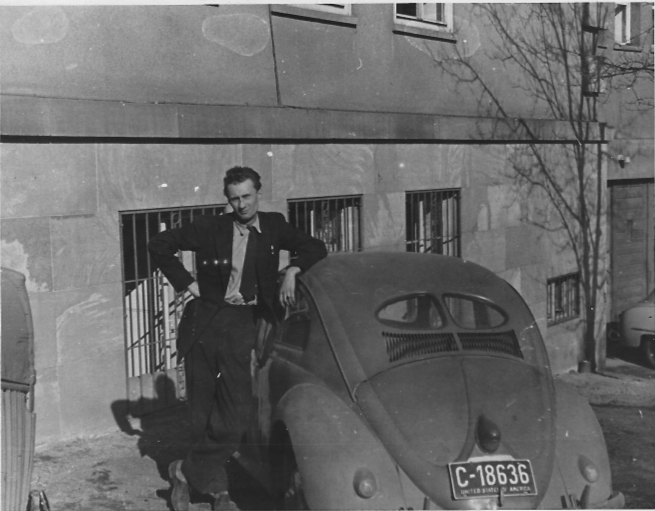
As a family we were entitled to free quarters, to a maid, and, if you had a house, you also got a gardener and a washer woman. And we hired on our own a driver, Böhm, an engineer from Sudeten Germany. He was an extremely nice guy.
And by that time, we were assigned a little house in Bad Schwalbach. Now, Mommy would know the exact date, I don’t remember it, but it was after my father had died.
I told you before that my father was a very sick man. He was happy to be in Wiesbaden and this winter after his arrival was a happy time for him although he very much longed to return to Vienna and resume participation in the reconstruction of Austria or what have you. I tried to talk him out of it because I had been to Vienna before my family arrived. I will tell you about that trip separately. It was no place to go back to. It was a cold winter. In the beginning of 1947 (I think it was in February) we made a trip out to the Rhine,

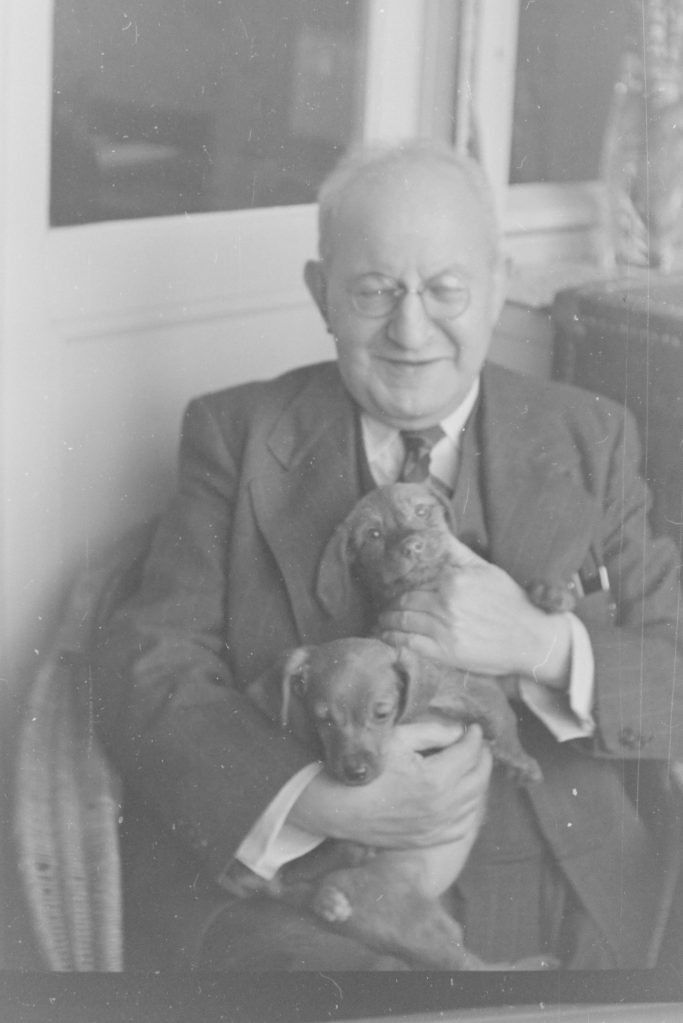
and after that — he was very cold and after we came back — he had a fever. We brought him to a hospital; a couple of days after, the doctor had recommended to bring him to the hospital. There we were told that Father was a very sick man. They found he had a double pneumonia, in addition to uremia.
Now I was carefully prepared by the doctors that nothing could be done for him for the, against the uremia, which is a disease where urine gets into the blood stream, and it depends of whether the poison gets to the heart first or to the brain first. If it goes to the brain, then the whole control, muscular and nerve control, ceases and it is a pretty horrible spectacle for the bystanders. One kind thing about this disease is that the patient doesn’t suffer. He has fantasies. He doesn’t suffer any pain and we watched for, I believe, close to two weeks where these young doctors in the hospital took very nice care of my father. He got nurses for 24 hours around the clock, sitting by his bed to keep him from falling out, and we were there, Mommy and I, as often as we could. Most of the time he was fantasizing and talking about snatches of understandable or not understandable sentences. At one time I had the feeling that he was totally lucid when he said to me, and he knew it was I, “I want to be buried next to Cilla,” next to his wife, and then he again lost track of what he was saying. He seemed to have been constantly under the impression that people wanted to, were outside waiting to visit him. He said, “Make them come in,” and that sort of thing. It was a sad spectacle, but it was good to know that he was visibly not suffering from any pain. He was just uneasy, agitated, if you will. Then, one day, I was called in the office. “Come to the hospital.” It didn’t come unexpectedly. I went there and it was the end. I closed his eyes and that was it.
I think that was in March, in the beginning of March 1947. He was cremated under the auspices of the army, cremated in a crematorium in Wiesbaden. I had expressed the desire to have him — have the ashes, the urn — brought to Paris, to be placed in Père Lachaise next to the resting place of my mother. The army arranged this. They were going to hand me the box for the urn, and I explained that I don’t see myself traveling with a box in my hand containing the ashes of my father. They fully understood that and sent an honor guard of two soldiers to Paris who handed it over to me. I drove to Paris. I don’t know why I was alone; Mommy wasn’t with me. At the railroad station they handed me that with an American flag. And I had hired a taxi driver, had explained to him what this was all about, and told him I don’t want to transport this box in my car. I’ll drive out to the Père Lachaise, or he should take the box and drive it out, and I’ll follow him. And when we got there, I had made arrangements – yes, I had gone to Paris before to make the necessary arrangements at the cemetery — and the driver whom I wanted to pay off was apparently disturbed that I was all by myself and insisted, on his own, to be with me while the urn was placed in the place which you know.
Mommy and I were emotionally, completely drained. These long wakes at the bedside of somebody whom you love and who you know is going to die is a difficult time indeed. We didn’t want to see anybody the night when it happened. Eventually we resumed living. I was busy in the office. Mommy was busy moving. I believe it coincided almost with our move, or the move was shortly afterwards. It may very well have been the reason why Mommy didn’t come with me. I do not at this moment know why I went alone to Paris. And we moved to Bad Schwalbach with Lenchen into the small house, where Mommy was pregnant, or became pregnant, with you. I must figure it backwards from your birthdate, at what time we decided to have a child.
That in itself is a story because during the war– I recently found a letter in which Mommy and I discussed having children — we were apparently both agreed that in the middle of the war, this was no time, and not the kind of a world into which, to bring children. But things had changed. I now had an interesting job, we had suddenly the means for it, and we discovered, somehow, to our mutual surprise, that each of us, very much, wanted a child but thought the other one didn’t. And well, we finally came to the conclusion we both do and set out to have a child and did. It was a long pregnancy. I believe you have heard that story. It lasted for a total of ten months, if you please.
 Victor Gruder